What “Swiss made” legally requires, before you pay for it
This matters more on a $500 watch than on a $5,000 one, because at $500 the label is most of what the premium is buying. It is not a marketing phrase: it is a legal definition with five conditions, and all five have to be met.
A watch may be labeled “Swiss made” only if its technical development is carried out in Switzerland, its movement is Swiss, the movement is cased up in Switzerland, the manufacturer carries out the final inspection in Switzerland, and at least 60% of the manufacturing cost is generated in Switzerland. The movement itself counts as Swiss when it is assembled and inspected in Switzerland, at least 60% of its manufacturing cost is Swiss, and Swiss-made components account for at least half its value excluding assembly. The 60% floor was set for all watch types by the Federal Council in 2016.
Two things follow from that, and they are the two things to actually take away. First, “Swiss movement” and “Swiss made” are different claims — a watch can carry a Swiss movement and still not qualify for the label, and a lot of watches in this price range are careful to say the former. Second, 60% is a real bar but it is not 100%, so a Swiss-made watch at this price is a watch with a genuine Swiss cost base rather than a watch made entirely in Switzerland by hand. Both brands on this page are Swiss: Tissot is a Swiss watchmaker owned by the Swatch Group, founded in Le Locle in 1853, and Victorinox was founded in Ibach, Switzerland in 1884 as Messerfabrik Carl Elsener, took the Victorinox name in 1921 and is the world’s biggest maker of pocket knives — it licenses its logo for watches, which is worth knowing, and it publishes a full specification block with a country of origin on each watch’s own product page, which is where every Victorinox spec on this site is read from.
The four compared, from the published spec sheets
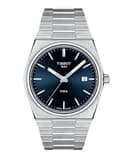
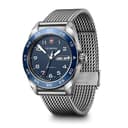
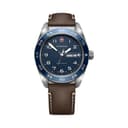
The two Victorinox references are the same watch with a different band — same 42mm case, same Ronda 517 day-date caliber, same 100m rating — which makes them the cleanest band comparison on the site, and the reason they both appear here. The leather one is the one that fits out of the box. The mesh one slides and locks anywhere along the weave, so it fits a wrist you were never able to measure, which is the argument on mesh strap watches and the whole of leather versus metal. Both of them move across the $500 line often enough that one of the two awards above is always conditional, and which one it is changes — so neither is written as a fixed price claim. The button carries whatever each costs today, and the band count at the top of this page is read from the live layer rather than typed into the copy.
The crystal column is where this page stops being flattering. Tissot publishes a sapphire crystal on both references, which at this money is exactly what you want: sapphire scores 9 on the Mohs hardness scale and mineral glass sits in the low 6s, so on the one component you look at every day it is the difference between a watch that still looks new in five years and one that does not. Victorinox does not publish a crystal material at all — not on these references and not anywhere in the specification block it otherwise fills out in full, down to the lug width and the country of origin — so our entries say “not published” rather than assuming sapphire at $500. We are not calling it mineral. We are saying the brand will not tell us, on a watch where the spec would be a selling point if it were sapphire. Draw your own conclusion; our crystal guide explains why it matters, and sapphire crystal watches lists everything we track that publishes one.
The Ronda 517 in both Victorinox references is worth knowing about. Ronda is a Swiss movement manufacturer, and a named Ronda caliber means a movement a watchmaker anywhere will recognize, with parts that exist. That is a real advantage over an unnamed “Swiss quartz” movement, and the two Tissots do not name a caliber on the listings we read.
Why Swiss quartz is the right buy at this ceiling
It sounds like a consolation prize and it is not. Three reasons, in order of how much they matter to somebody who will actually wear the watch.
Accuracy. A quartz watch keeps time to within seconds a month. A mechanical watch at any price keeps time to within seconds a day, and the good ones are specified in a range rather than a figure. If the recipient is the kind of person who notices a watch being two minutes out, quartz is not the compromise — it is the correct answer, and the Swiss-made quartz watches on this page give you the label and the accuracy at once.
Maintenance. A mechanical watch runs on lubricants that age whether it is worn or not, and a full service costs a meaningful fraction of a $500 watch — our servicing guide has the honest numbers. A quartz watch needs a battery every few years, and that is the whole of it. For a gift, where you have no idea whether the recipient will ever take a watch to a watchmaker, that difference is larger than it looks.
Thinness. A quartz movement is flatter than a mechanical one, which is why a Swiss quartz dress watch slides under a shirt cuff in a way the automatic version of the same design usually will not. On the Everytime in particular, the thinness is the design.
What you give up is the thing the enthusiast cares about: no battery, a moving mechanism, and the small pleasure of a watch that runs off the wearer’s own motion. If that is the point of the gift, the right move at this budget is to stop insisting on Swiss. An Orient or a Seiko gives you an in-house mechanical caliber for less than any watch on this page, which is the finding on Japanese versus Swiss and the reason best Japanese watches exists as its own list.
What the next few hundred dollars buys, if the ceiling can move
Three steps up from this band, each one buying a specific thing rather than a vague upgrade, and each one is a page on this site rather than a sales pitch.
A little over the band, a case that will take abuse. The Victorinox I.N.O.X. Quartz is a 41mm Swiss quartz watch rated to 200m with an interchangeable rubber strap, built as the brand’s deliberately over-engineered reference. It is the one to look at for somebody hard on a watch; it sits on best Swiss watches rather than here, because it does not come under this ceiling.
Further up, a Swiss chronograph with a named caliber. The Victorinox Swiss Army Chrono runs a Ronda 5030.D, which is the best-documented Swiss quartz chronograph movement in this range. If the gift is specifically a chronograph, it is also the Swiss answer on Speedmaster alternatives.
At roughly double this ceiling, the actual Swiss automatic — and an 80-hour power reserve. The Tissot PRX Powermatic 80 is the same case and bracelet as our top pick with a Swiss automatic inside it, and the 80 in its name is the thing that changes daily life: left in a drawer on Friday, it is still running on Monday. That is the single upgrade at the next tier worth stretching for, and it is the top of under $1,000. Every figure in this section is a bracket rather than a price — the live number is on each watch’s own button, read by our daily price check.
The one to skip — and why
Skip any watch under $500 that advertises “Swiss movement” but never says “Swiss made,” unless you know that is what you are buying — the two are different legal claims, and the cheaper one is usually chosen deliberately. Skip, too, a Swiss-made quartz watch bought purely so the dial says Switzerland: at this price the label costs real money and buys you a cost base rather than a better movement, and a Japanese watch at half the price will often publish a better specification. The clearest case is the crystal — we track watches at a third of this price that publish sapphire, and one brand on this page will not publish a crystal material at all. And skip the 30m references for anyone who will not take a watch off: 30m means rain and hand-washing, not swimming, which is on the Everytime and not on the PRX. Our water resistance explainer has the full ladder.
Which one, for which recipient
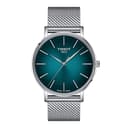
Someone who wants one watch for everything gets the PRX Quartz — 100m, sapphire, and a bracelet that reads as dressy or casual depending on what it is next to. It is also the only watch here that will get a comment from a person who knows watches. Someone who wears a suit and nothing else gets the Everytime, with the warning that 30m means it comes off before a shower. Someone who wants a plain, legible Swiss watch for work gets a Victorinox — a day-date at 42mm with a named Ronda caliber and 100m, in whichever of the two bands is under the ceiling on the day you buy.
If the wrist is slim, note that everything here is 40mm or 42mm, which is the top half of the normal range; the smaller options are on watches for small wrists. If you cannot measure the wrist at all, buy the mesh Victorinox, because a mesh clasp sizes itself to any wrist out of the box. And if $500 is above where you wanted to be, under $300 holds the Japanese watches that out-specify everything on this page, and under $500 is the mixed band page this one qualifies by country.