What counts as a small wrist
A wrist under about 6.5 inches around — roughly 16.5cm — is the point where standard modern watch sizing starts to work against you. That covers a great many women and a fair number of men, and it is worth saying plainly: this is a measurement, not a gender. The same 37mm case sits well on plenty of men and plenty of women, and the labels on the listings are marketing rather than fit.
The rule of thumb we use across the site is 34–38mm for a smaller wrist, 38–40mm for an average one and 42–44mm for a larger one, with women’s watches usually running 26–34mm because they are designed to read as jewelry rather than as instruments. Our watch size guide has the full wrist-to-case table if you want to check a specific measurement before you buy.
Diameter is only half the story
Case diameter is the number every maker publishes, so it is the number we publish on every card. It is not, however, the whole of how a watch wears. Two others matter, and neither is printed on most listings:
- How far the lugs reach. The lugs are the horns the strap attaches to, and they are what decides whether the watch sits on the wrist or hangs off it. A 38mm case with long, flat lugs can wear bigger than a 40mm case with short, curved ones. The practical test needs no numbers: look at the watch from above on the wrist, and if the corners overhang the edge, it is too big whatever the diameter says.
- How thick it is. A thick case on a slim wrist rocks, catches on cuffs and reads as bulky even when the diameter is right. This is the quiet reason dress and minimalist watches suit small wrists so well and dive watches so often do not.
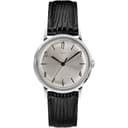
- How far the dial reaches. A thin bezel around a wide dial makes a small case look generous; a thick bezel makes the same case look mean. It is why the 34mm Timex on this page does not read as a tiny watch.
We do not invent those figures for watches we have not handled. Where a maker does not publish a spec, the card says “Not published” rather than guessing — that is the same rule we apply everywhere, and you can read the whole of how we pick if you want it.
For a gift, the band matters as much as the case
This is the part that separates buying for yourself from buying for someone else. You can order a watch for your own wrist, take the bracelet to a jeweler and have two links removed. You cannot do that with a surprise. A steel bracelet that arrives four links too long is a watch that does not fit on the day it is opened, however perfect the case size.
Bands fall into three groups, and for a gift they are not equal:
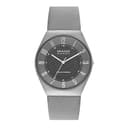
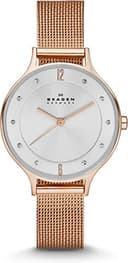
- Mesh, with a sliding clasp. The safest gift band there is. The clasp slides anywhere along the mesh and locks, so one watch fits almost any wrist with no tools and no trip out. Both Skagens here work this way — the listings call it a self-adjusting band with a safety buckle — which is most of why they lead this page.
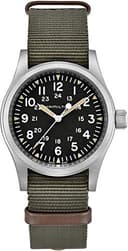
- Leather, canvas and fabric straps. Adjustable across a range of holes out of the box, and cheap to replace if the range is wrong. The Timex Marlin’s leather strap and the Hamilton’s canvas both land here. A strap is also the easiest thing to swap later, which our strap guide covers.
- Steel bracelets. The nicest to wear and the riskiest to give. They need links removed to fit, which means a jeweler, a $10 tool or a watch shop — our guide to resizing a watch band walks through it. Four picks here are on bracelets because they are excellent watches; just plan on the sizing being part of the gift.
If you genuinely cannot measure the wrist and cannot get the watch sized before you hand it over, buy mesh or a strap. That single decision removes most of the risk from a watch gift, and it costs nothing.
How to measure a wrist without giving the game away
Two ways, neither of which involves asking. Wrap a strip of paper or a piece of string around the wrist where a watch would sit, mark where it meets, and hold it against a ruler — that number is the wrist measurement, and under about 6.5 inches puts you firmly on this page. Or, easier still, measure a watch they already own: lay a ruler across the case, edge to edge, ignoring the crown. If a watch they wear happily is 36mm, another 36mm watch will be welcome.
If both are impossible, the safest gift is a smaller case on an adjustable band. A watch that is slightly small reads as classic and deliberate; a watch that is too big just looks like it belongs to someone else. When you are torn between two sizes, take the smaller one.
What changes as the price climbs
The eight picks span a wide range, and the differences are worth knowing before you decide how much to spend:
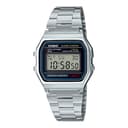
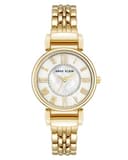
- Around $25 to $50 buys a genuine design classic in a genuinely small case — the 33mm Casio on its steel bracelet, or the 30mm Anne Klein that reads as jewelry. Both are splash-resistant only, both are quartz, and neither pretends otherwise.
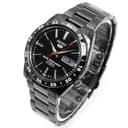
- Around $100 to $250 is the sweet spot for this brief. It buys a self-adjusting mesh band, a solar movement that never needs a battery, or a real mechanical watch — the self-winding Seiko 5 or the hand-wound Timex Marlin.
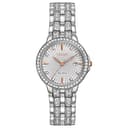
- Above $250 buys the specs that outlast the trend: a Swiss hand-wound movement with an 80-hour power reserve and a sapphire crystal on the Hamilton, or a light-powered Citizen that will still be running years after a fashion quartz has stopped.
Note what does not improve with price: fit. The 33mm Casio fits a small wrist exactly as well as the $675 Hamilton, and rather better than most watches costing far more. Spending more buys the movement, the crystal and the finish — not a better size. Our value hub walks the same ladder for watches of every kind.
Styles that suit a smaller wrist — and one that rarely does
Dress watches and minimalist watches are the natural fit: slim cases, thin bezels, nothing added. A field watchworks too — the style descends from military watches that were made small on purpose, which is why the 38mm Hamilton here is a classic small-wrist recommendation rather than a compromise.
Dive watches are the hard case. Real ones run 40mm and up, and they are thick, because the water resistance and the rotating bezel need the room. If the person you are buying for wants a diver and has a small wrist, that is a genuine trade-off rather than a problem to solve with a smaller diver that is not really one. Chronographs have the same problem for the same reason: sub-dials need diameter to stay legible.
The one to skip — and why
Skip the oversized chronograph, however good the deal looks. A 44mm case with three sub-dials is the single most common small-wrist mistake, and no amount of strap swapping fixes it. Skip a steel bracelet if you have no way to get it sized before you hand it over — buy the mesh or the strap version of the same idea instead. And skip the Timex Marlin for anyone who would find winding a watch every morning a chore rather than a small pleasure: it is hand-wound, it has no battery and no automatic winding, so it stops overnight if it is not wound. For that person the Skagen or the Citizen does the same job and asks for nothing.