Where sapphire starts, and what it displaces
Here is the pattern in our own registry, which is the most useful thing we can tell you about this spec. Of the 96 watches we track, the ones that publish a sapphire crystal are 14, and they are not spread evenly across the price range: there is nothing sapphire below about $160, and above about $300 it becomes normal rather than notable. The 82 watches without it are not bad watches — several are our top picks on other pages — they have mineral glass, Hardlex (Seiko’s own hardened mineral) or, on several Timex references, acrylic.
What that means for a gift decision is simple. At $20 to $150, do not shop for sapphire — shop for the right size and band, and accept the crystal you get. Our under-$100 picks are chosen on exactly that basis. At $150 to $350, sapphire is the single best use of the next $50, and every pick above is in that band or just past it. Past $350 you are paying for the movement and the finishing, and sapphire comes along with it.
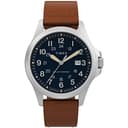
One thing to be careful about while shopping: “mineral crystal”, “hardened mineral”, “Hardlex” and “sapphire-coated” are all different from sapphire, and only the last one is trying to sound like it. A coating is microns thick and wears through at the edges; the crystal underneath is still mineral. Where a maker publishes a coating rather than a solid crystal, we record it as what it is — the Timex Expedition North above publishes an anti-reflective treatment on a sapphire crystal, which is the right way round.
The seven compared, from the published spec sheets
| Pick | Case | Movement | Water resistance | Band |
|---|
| Timex Expedition North Field Post Solar | 41mm | Solar quartz | 100m | Leather, quick-release |
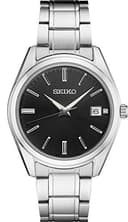
| Seiko Essentials SUR311 | 40.2mm | Quartz (6N52) | 100m | Steel bracelet |
| Citizen Peyten Eco-Drive EO1222-50P | 33mm | Eco-Drive solar | 100m | Gold-tone bracelet, 16mm |
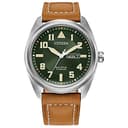
| Citizen Garrison Super Titanium BM8560-02X | 42mm | Eco-Drive solar | 100m | Leather |
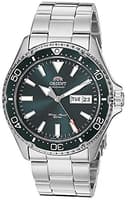
| Orient Kamasu | 41.8mm | Automatic (F6922) | 200m | Steel bracelet |
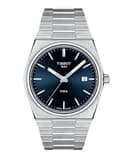
| Tissot PRX 40mm Quartz | 40mm | Swiss quartz | 100m | Integrated steel bracelet |
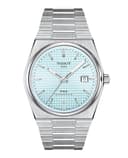
| Tissot PRX Powermatic 80 | 40mm | Swiss automatic | 100m | Integrated steel bracelet |
The column that surprises people is water resistance: six of the seven are rated to 100m or better, which is unusual for a list this dressy-looking. That is not a coincidence. A maker who pays for sapphire is generally building a watch to last, and the sealing tends to follow. The water-resistance guide explains why 100m is the number that makes a watch genuinely unbothered by daily life, and why 30m does not cover a shower.
The column that should decide your purchase is movement, because it is the thing the recipient will notice daily. Two of the seven are solar — they never need a battery and the caseback is never opened. Two are automatic, which means they are mechanical, they stop if they sit in a drawer, and they feel like something. Three are quartz, which is the one that just works. Our movements explainer puts that choice in plain English, and it matters more than the crystal does.
The finding: sapphire at gift prices is mostly a men’s-size spec
Of the fourteen sapphire references in our registry, exactly one is a women’s watch — the 33mm Citizen Peyten above — and the rest run 38mm to 45mm. We are not going to dress that up. If you are buying for a smaller wrist and sapphire is a requirement, the Peyten is the pick, and after that the honest options are a 40mm unisex three-hander worn deliberately large, or dropping the sapphire requirement and buying on size from our small-wrist roundup instead. This is the same shape of gap we found on titanium, where there is no women’s reference at all in this price range, and it is worth knowing before you spend an evening searching for something that is not being made.
A related pattern worth naming: four of the fourteen are the Citizen Super Titanium references, so if you are already paying for sapphire, titanium is often only a little further — and it is the upgrade the wearer feels rather than sees. Our titanium versus steel comparison is the page for that trade.
Three sapphire watches that are not on this list, and why
The Hamilton Khaki Field Mechanical. A 38mm hand-wound Swiss field watch with a sapphire crystal and an 80-hour power reserve — on paper the most interesting sapphire watch we carry, and the only hand-wound one. It is not a card on this page because its listing is not currently returning a price through our price layer, and we will not feature a pick we cannot price. It is covered on Tissot versus Hamilton if that is the watch you want.
The Bulova Lunar Pilot and the Tissot Everytime. Both publish sapphire and both are good watches; the Lunar Pilot is a 45mm chronograph, which is a lot of watch for a gift bought without a wrist measurement, and the Everytime is rated to 30m, which is the one spec on this page we would not accept at the price. They are on our chronograph and dress watch roundups where those trade-offs are the point.
The one to skip — and why
Skip anything advertised as “sapphire-coated”, “sapphire glass hardened mineral” or “9H sapphire film” — those are mineral crystals with a treatment, and the treatment is the first thing to go. Skip the sub-$80 listings that claim a sapphire crystal with no published caliber, no water-resistance rating and no warranty: a solid sapphire crystal is one of the more expensive parts of a cheap watch, and a listing that claims one while publishing nothing else is not a bargain, it is an unverifiable claim. And skip paying for sapphire on a watch whose band does not fit — an unworn watch with a perfect crystal is still an unworn watch, which is why size comes before every spec on this site.
Two of these are Swiss, and that is a separate decision
The two Tissot picks above cost roughly three and six times what the Timex at the top of the page costs, and only part of that gap is the crystal — all seven picks here have the same sapphire. What you are paying for is the finishing, the integrated bracelet and the name on the dial, plus a Swiss automatic movement on the dearer one. Whether that premium is the right use of a gift budget is exactly the argument on Japanese vs Swiss watches, which has what “Swiss made” legally requires and the one thing only the Japanese side offers in this range.
Where a sapphire crystal is the argument
Sapphire is the spec that does most of the work on two of our comparison pages. Tissot PRX alternatives turns on it: the PRX sells on four things, the crystal is one of them, and the Seiko and Citizen references on this page keep it for a good deal less. Rolex alternatives uses it the same way — a plain steel watch with a sapphire crystal and 100m is most of what people are reaching for.