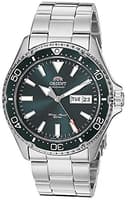
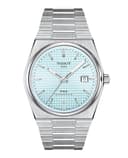
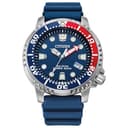
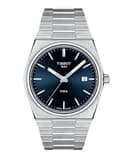
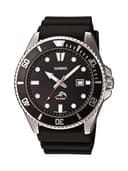
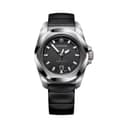
What the Swiss premium buys at these prices
Three real things, and it is worth separating them from the marketing.
- Finishing. This is the honest one. A Tissot PRX bracelet and case have a level of polishing, edge definition and bracelet integration that the Japanese watches at half the price do not attempt. You can see it in person and you can feel it on the wrist. It is not a performance specification; it is craft, and some people care about it a great deal.
- Recognition. Tissot and Victorinox are names a recipient is likely to know, and “Swiss made” on a dial carries a meaning the legal definition above actually backs up. For a milestone gift — a retirement, a milestone birthday — that can be the whole point of the object.
- A specific kind of movement. The Powermatic 80 in the PRX runs about 80 hours off a full wind, which is roughly double what the Seiko automatics we carry publish, and it means a watch worn Monday to Friday is still running on Sunday night. That is a genuine, checkable advantage.
What the premium does not buy, at this price: better accuracy (both sides use quartz for that, and Swiss quartz is not more accurate than Japanese quartz), more water resistance, or a longer warranty by default. Our Tissot versus Seiko page runs the same argument at the brand level, model by model.
The one thing only the Japanese side offers
A watch that never needs a battery. Citizen’s Eco-Drive and Seiko’s and Casio’s solar movements run on light, which means the caseback is never opened, the seal is never disturbed, and the recipient never has to find a jeweler. In the ranges this site covers there is no Swiss equivalent — none of the Swiss references we carry is light-powered. For a gift that is frequently the single most useful fact on this page, because the most common way a gift watch dies is a flat battery nobody replaces.
The reverse case is narrower but real: there is no Japanese watch in our registry with an 80-hour power reserve, and no Japanese reference we carry is built to the Victorinox I.N.O.X. standard of impact testing. If either of those is the requirement, the Swiss side wins it outright. Our Victorinox roundup covers what that testing claim involves.
The two traditions, side by side
| | Japanese (Seiko, Citizen, Casio, Orient) | Swiss (Tissot, Victorinox, Hamilton) |
|---|
| In our registry | 34 watches | 10 watches |
| Entry price | About $20 | About $350 |
| Light-powered option | Yes — Eco-Drive and solar | None in this range |
| Cheapest in-house automatic | Under $300 | Past $800 |
| Longest power reserve | About 41 hours | About 80 hours |
| Origin label | No equivalent legal standard | “Swiss made”: 60% of cost, movement and final inspection in Switzerland |
The row that settles most gift decisions is entry price. The Swiss range effectively begins at about $350, which is above the budget of most gifts bought on this site. If your budget is under $300, this comparison is already decided for you and the question becomes which Japanese watch — our Seiko versus Citizen page is the next fork, and under $300 is the field.
What “Swiss movement” means when it is not “Swiss made”
You will see both phrases, and they are not the same claim. The full “Swiss made” label carries the five conditions above, including the 60% cost floor and final inspection in Switzerland. “Swiss movement” alone says only that the movement meets the movement test — the watch around it may be assembled anywhere. Both of the Victorinox quartz references we carry publish a Ronda caliber, which is a Swiss movement house rather than a watch brand; that is a real and checkable thing to publish, and it is more than most brands at the price will tell you.
The Japanese equivalent of this disclosure is the caliber number, and it is worth looking for on either side. An Orient F6922, a Seiko 4R36, a Citizen E168: a maker that prints a caliber is telling you what is inside and can be held to it. A listing that says only “Japanese quartz movement” or “Swiss movement” with no caliber is telling you less than it appears to.
Which to gift, by recipient
- Buy Japanese if the budget is under $350, if the recipient will not maintain a watch (light-powered settles it), if they want a dive watch they can actually swim in, or if they are the sort to value what is inside over what is on the dial.
- Buy Swiss if the gift is a milestone and the name on the dial is part of the message, if the recipient already owns watches and would notice the finishing, or if an 80-hour reserve or the I.N.O.X. impact testing is a specific requirement.
- Do not buy either on the strength of the country. Case size, band and movement decide whether a watch gets worn; origin decides how it is described. Our five-step chooser puts them in the order that matters, and the gift-brand rankings sort the whole field regardless of where it was made.
One last honest note on the thing people most want to hear about: resale. Neither tradition at this price is an investment. We looked at whether watches hold their value and the answer, at gift prices, is largely no — that guide has the detail and the reasons, and it applies to both columns of the table above.
One corner of this where Japan is unopposed
Digital watches. The cheapest watch in our whole registry is a Japanese digital Casio at about $20, every reference we track that publishes a numeric battery life is a digital Casio, and there is no Swiss digital watch in this range at all. Whether that format is the right gift is a separate question with its own page — analog vs digital — and the short version is that a digital watch wins on every specification and an analog one wins on whether it gets worn.
If you have already decided, here are the two lists
This page decides between the two. If it has settled the question for you, the commercial follow-ups are best Japanese watches — Seiko, Citizen, Orient and Casio, ranked, with the budget pick named — and best Swiss watches, which starts where Swiss-made actually starts rather than where the marketing implies. Both are built from the same registry and the same published spec sheets this comparison uses.
If you came to this comparison with a number already in your head, there is a third page that answers it directly. Swiss watches under $500 is the price-qualified version of the Swiss half, and its finding is the sharpest form of the argument above: at that ceiling Swiss means Swiss quartz, because the cheapest Swiss self-winding watch we can sell you is nearly twice the limit, while a Japanese automatic with an in-house caliber sits well under it. It is the clearest single illustration of what the Swiss premium does and does not buy at gift prices.