Sizing: the one difference that can spoil the gift
A watch band attaches the same way whichever material it is — a spring-loaded double-ended pin called a spring bar, anchored into holes in the lugs, which is a largely standardized fitting and the reason bands can be swapped at all. What differs is how each one is made to fit a wrist.
Leather is adjusted by the buckle. A strap has five to seven holes punched in it, covering roughly an inch and a half of wrist circumference, and the recipient simply uses the hole that fits. If their wrist falls outside that range — genuinely slim, or genuinely large — the fix is a new strap rather than a tool, and a replacement strap is a cheap, easy purchase. On a gift that arrives unmeasured, leather almost always just works.
A link bracelet is adjusted by removing links. Depending on the brand the links are held by friction pins, push pins or tiny screws. Pins are doable at home with a $10 tool and patience; screws are the point at which we would send you to a jeweler. Our guide to resizing a watch band is the honest walk-through. Many bracelets also have a couple of micro-adjustment holes in the clasp, which buys a few millimeters and not more.
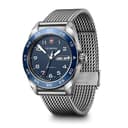
And there is a third option that is metal and needs no sizing at all. A mesh bracelet has no links: the clasp slides and locks anywhere along the woven band, so it sets by hand in seconds. That is the Victorinox 242042 above, and it is why we built a whole roundup of them — the best mesh strap watches — for exactly the buyer who wants metal and cannot measure a wrist.
The three pairs, from the published spec sheets
| Pick | Band | Case | Movement | Water resistance | Fits out of the box? |
|---|
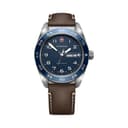
| Victorinox Swiss Army Quartz 242040 | Brown leather, 21mm, buckle | 42mm | Swiss quartz (Ronda 517, day-date) | 100m | Yes |
| Victorinox Swiss Army Quartz 242042 | Steel mesh, 21mm, sliding buckle | 42mm | Swiss quartz (Ronda 517, day-date) | 100m | Yes — set by hand |
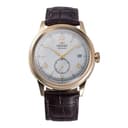
| Orient Bambino Version 7 | Leather, buckle | 38.4mm | Automatic (Orient F6222) | 30m | Yes |
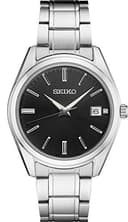
| Seiko Essentials SUR311 | Steel link bracelet | 40.2mm | Quartz (Seiko 6N52) | 100m | No — links to remove |
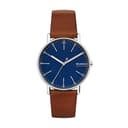
| Skagen Signatur SKW6355 | Brown leather, 20mm, single-prong buckle | 40mm | Quartz | 50m | Yes |
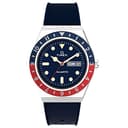
| Timex Q Reissue 38mm | Steel link bracelet | 38mm | Quartz | 50m | No — links to remove |
Look at the top two rows again, because they are the whole argument in one place: identical case, identical caliber, identical 100m rating, identical 21mm lugs — and one of them fits itself. When a maker offers a watch both ways, the band is genuinely the only decision, and the gift logic points at whichever one does not need an appointment.
Water and sweat: a 100m rating describes the case, not the strap
This is the point most band comparisons skip. Water resistance is a property of the watch case and its gaskets. It says nothing about the band. The Victorinox 242040 is rated to 100m on a leather strap, and that rating is honest — but the strap is not rated for anything. Repeated soaking stiffens leather, darkens it, and eventually cracks the fold where it bends at the lug.
So the practical rule is simple:
- If the recipient will swim, shower or sweat heavily in the watch, buy metal. Steel is unbothered — its corrosion resistance comes from a chromium content of at least 10.5%, and the marine-grade alloys used in better bracelets add molybdenum specifically for chloride resistance. Rinse it and move on.
- If the watch is for an office, a dinner or a drawer, leather is fine — and it is the more comfortable band in a warm room, because metal holds the ambient temperature and leather does not.
- Either way, check the case rating separately. Two of the picks above publish 30m and 50m, which cover rain and hand-washing but not a shower. Our water-resistance guide has the whole ladder, and can you shower with a watch answers the one people ask.
Five-year cost: leather is a consumable, metal is not
Nobody puts this on a spec sheet, so we will say it plainly. A leather strap is a wearing part. Worn daily it creases, stretches, absorbs sweat and eventually tears at the spring-bar hole — and no maker publishes a service life for one, because it depends entirely on the wearer. A replacement strap from a reputable seller is an inexpensive purchase, so the cost is small; it is the recurrence that matters. Over five years of daily wear, expect to buy a strap or two.
A steel bracelet will outlast the movement. It scratches — brushed steel hides it, polished steel does not — and a clasp can eventually loosen, but nothing about it is consumed. If the gift is meant to be the kind of object that gets handed on, the bracelet is the honest answer.
There is a middle path worth knowing about: a watch with quick-release spring bars, which let the owner swap bands in seconds with no tool at all. Where a maker fits them we say so on the product card, and a watch plus a second band is a genuinely good present in its own right — our watch and strap gift page covers how to do it without buying the wrong lug width.
Formality: the rule, and the two places it is wrong
The convention is that a thin leather strap is dressier than a bracelet, and for most of the last century that held: the dress watch was a slim case on a dark leather strap, and the steel bracelet belonged on a sports watch. If you are buying something to be worn with a suit, leather is still the safer read, and our guide to what watch to wear with a suit goes through it.
Two exceptions have become mainstream, and both are worth knowing so you do not overthink the gift. First, the integrated-bracelet dress watch — a thin case and a tapering steel bracelet designed as one piece — is now as formal as anything on leather; it is the whole reason the Tissot PRX exists, and it is on our dress watch roundup. Second, a fine mesh bracelet reads dressier than a chunky link one, because it is thin and quiet, which is how the Skagens and the Victorinox mesh get worn with a jacket.
The rule that actually survives contact with real life is about thickness, not material: thin and quiet is dressier than thick and loud, whatever it is made of.
Comfort, weight and skin
Three things decide which band a person actually enjoys wearing, and none of them is on the listing.
Weight. A steel bracelet can add a meaningful fraction of a watch’s total weight, and steel is dense — roughly 7.5 to 8.0 grams per cubic centimeter depending on the alloy. Some people love that heft and read it as quality; others find it fatiguing by the end of a day. Leather is close to weightless by comparison. If the recipient has never worn a watch, the lighter band is the lower-risk gift.
Temperature and sweat. Metal is cold on a winter morning and holds heat in summer; leather does neither, but it is the one that absorbs sweat and eventually smells if it is worn every day in heat. For a hot climate or a physical job, metal is less pleasant for ten minutes and better for five years.
Skin. If someone reacts to inexpensive jewelry, a metal bracelet is the band that provokes it — nickel allergic contact dermatitis shows up as a red, itchy rash where skin is in regular contact with nickel-releasing metal, and the standard advice is avoidance rather than treatment. In that case leather is the easy answer and titanium is the good one; our sensitive-skin guide and titanium versus steel comparison both cover it.
Can you swap one for the other later?
Usually yes, and it is the cheapest upgrade in watches. You need one number: the lug width in millimeters, which is the gap between the lugs where the band sits. Most men’s watches are 20mm or 22mm, most women’s are 12mm to 16mm, and the picks above run from 20mm to 21mm — which is a good example of the catch, because 21mm is an awkward size with far fewer aftermarket options than 20mm or 22mm. We publish the lug width on every product card where the maker publishes it, precisely so this decision is checkable before you buy.
The exception is an integrated bracelet, where the band is designed as part of the case and there is no standard lug gap to measure. Those cannot be swapped for a generic strap, and that is a reason to be sure about the band before you buy the watch. Our how to change a watch strap guide covers the actual mechanics, and watch band types is the full taxonomy if you want to see what else exists — NATO, rubber, silicone and the rest.
The one to skip — and why
Skip the “genuine leather” claim as a quality signal. It is the lowest grade of real leather and tells you almost nothing; the grades that matter — full-grain, top-grain — are the ones a maker names when it has them, and at gift prices most listings simply say genuine leather and leave it there. Judge a strap by its stitching and its thickness in the photographs instead. Skip, too, a polished steel bracelet for anyone who works with their hands: polished links show every scratch within a month, where brushed steel hides them for years, and the scratches are the thing people regret. And skip buying a watch you like on a band you do not, on the assumption you will change it — check the lug width first, because a 21mm or an integrated bracelet turns a $25 fix into a problem.
So which one?
Our honest summary, in the order a gift buyer should apply it. If you can measure the wrist and the recipient is active, buy the metal bracelet. It will outlive the watch and shrug off everything they do to it. If you cannot measure the wrist, buy leather or buy mesh — leather for warmth and formality, mesh for metal that needs no sizing. If it is a dress gift, buy leather or an integrated bracelet, and judge it on thinness rather than material. And if you are still undecided, pick the watch you like on either band and remember that for most watches the other one costs very little later.
Both sides have a roundup of their own: leather strap watches and mesh strap watches. If the metal you are weighing up is a finish rather than a band, gold versus silver is the other half of that decision.
The lists behind each side
Whichever way this decision went, the commercial follow-up is a roundup rather than another comparison: leather strap watches, mesh strap watches for the metal band that needs no sizing, and steel bracelet watches for the metal band that does — including which two clasps on our picks adjust by hand, and why a hollow link is the one construction to avoid.