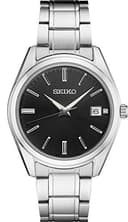
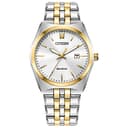
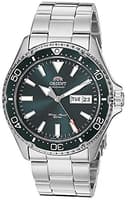
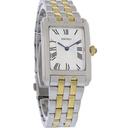
The four brands, and what each one is actually for
Seiko is the default. It sells watches from the very cheap end of the market right up into the thousands, which means the name carries no embarrassment at any price. For a gift that matters most, it is the brand least likely to be wrong. Its full brand page is here, and the one spec to watch for is the crystal: Seiko fits its own Hardlex glass to much of the range and sapphire only to some of it.
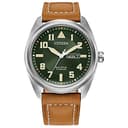
Citizen is the answer to a practical problem. Eco-Drive is a solar cell under the dial that charges a rechargeable cell from any light, including room light, so the watch never needs a battery change. If the recipient is the sort of person who has three watches in a drawer with dead batteries in them, this is the brand, and the Citizen page has the range. Citizen also makes the only titanium we can verify at this money, which is why its Super Titanium references appear on our titanium roundup.
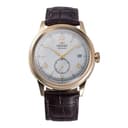
Orient is the value play, and it is not close. Orient sells genuinely in-house mechanical watches — the F6922 in the Kamasu and Mako, the F6222 in the Bambino — at prices where most brands sell quartz. The Kamasu publishes a sapphire crystal and 200m for less than the price of a Swiss quartz dress watch, which is the single best spec-per-dollar on this site. The Orient page is the deepest version of that argument, and Orient versus Citizen is the fork most people actually face.
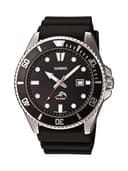
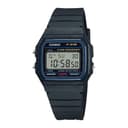
Casio is for when the watch is not the point. The F-91W, the Duro rated to 200m, the steel-braceleted A158: these are not compromises dressed up as bargains, they are competent watches at the bottom of the market, and they make excellent secondary gifts, stocking fillers and first watches for a teenager. The Casio page has the rest.
The eight compared, from the published spec sheets
Two columns in that table decide most of these purchases. The crystal is the one you see every day — sapphire scratches at 9 on the Mohs hardness scale, mineral glass in the low 6s, acrylic lower still, and a scratched crystal is the thing that makes a cheap watch look cheap after a year. Three of the eight publish sapphire. Water resistance is the one that ends watches: 30m on the Bambino is rain and hand-washing, not a shower, and our water-resistance explainer has the whole ladder.
“Made in Japan” is not the same as a Japanese brand
Worth knowing before you shop, because listings lean on it. All four of these companies build in several countries, and a Japanese brand name on the dial does not mean the watch was assembled in Japan. Seiko, Citizen, Orient and Casio all operate plants across Asia, and a large share of what they sell at gift prices is made outside Japan to the same published specifications. Some references carry a “Made in Japan” marking and command a premium for it.
Our position is that the marking is not what you are buying. The caliber, the crystal and the water-resistance rating are published numbers you can check; the country of assembly is a story. If a listing's only argument is a flag, treat it the way you would treat a watch that will not publish its water resistance. We do not record an assembly country on any entry in our registry, because the listings we read do not reliably publish one, and we would rather have an empty cell than a guess.
The one to skip — and why
Skip the deep end of the Seiko 5 and Citizen ranges on a marketplace you do not recognize. Counterfeiting is not only a luxury problem — inexpensive quartz watches are copied too, and the Swiss Customs Service has estimated that some 30 to 40 million counterfeit watches enter circulation every year. Buy from the brand's own storefront or a seller the retailer itself fulfils, and read our guide to spotting a fake and whether marketplace watches are genuine first. Skip, too, any listing on this page that will not name its caliber or its rating: all four of these companies publish both, so a listing that does not is telling you it is not the brand's own.
Which one, for which recipient
If you have one constraint and no other information: an adult who dresses for work gets the Seiko Essentials; someone who loses batteries gets the Citizen; someone who would find a mechanical watch interesting gets the Orient Kamasu; a teenager or a second gift gets the Casio. For a woman the Seiko Essentials SWR087 at 29.6mm is the same argument in the right size, and the rest of that list is on watches for women.
If the budget is the constraint rather than the taste, the band pages do the filtering for you: under $100, under $200 and automatics under $500, which is where the Orients on this page earn most of their recommendations. And if what you actually want is the mechanical thing rather than the brand, a first automatic watch is the page written for that.