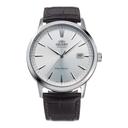
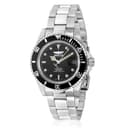
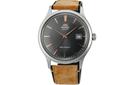
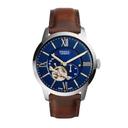
Four things decide a sub-$200 automatic. The price is not one of them
The spread on this page is roughly $90 to $200, which sounds like a lot until you look at what changes across it. These four criteria should decide it instead, in this order.
1. Is it actually automatic? This is a real trap at this price, because “automatic” is used loosely in listings and “automatic quartz” is a different thing again. An automatic watch winds itself from the motion of the wrist and runs with no battery at all. All four picks here are genuinely self-winding, and three of them publish the caliber: the Invicta runs a Seiko NH35A, the Orient Symphony III an in-house Orient F6722. If a listing will not name the movement, assume you are not being told something; our movements explainer covers the difference in plain English, and do automatic watches need batteries answers the question a gift recipient will actually ask.
2. What the movement publishes. A jewel count, a daily accuracy figure and a power reserve are the three numbers that separate a maker that stands behind its movement from one that would rather not discuss it. The Orient Symphony III’s listing publishes 22 jewels and +25/-15 seconds per day, which is the only accuracy figure on this page. Watch jewels are bearings made from synthetic sapphire or ruby, and their low, predictable friction is what makes a mechanical movement keep time over years rather than months.
3. Hand-winding, which matters more than it sounds. An automatic that cannot be wound by hand has to be shaken into life, and a watch that has sat in a drawer for a week arrives at a birthday with the hands stopped. Both Orients can be hand-wound as well as self-wound, per their listings. The Fossil is a two-hand skeleton automatic, and the Invicta’s NH35A is a hand-windable caliber. Our how to set an automatic watch guide is the thing to put in the box with it.
4. Water resistance, honestly read. This is where the band splits hard. The Invicta publishes 200m, which covers swimming and more. The Orient Symphony III publishes 5 ATM — and Orient’s own feature bullet says in the same breath that it is not suitable for swimming, which is a conservative reading of its own rating and we pass it on rather than rounding it up. The Fossil publishes 50m and the Bambino 30m — a dunk and a rinse respectively, and neither of them is swimming. Our water resistance explainer has the full ladder.
Why three of the four are Japanese, and why that is good news
It is not a coincidence and it is not a compromise. When quartz arrived in the 1970s and 1980s it largely replaced mechanical watches worldwide; the Swiss industry stayed focused on mechanical watchmaking and declined sharply, while production shifted to Japanese companies — Seiko, Citizen and Casio — that embraced the new electronics. What came out of that period is the reason this page exists: Japan kept making affordable mechanical movements at scale while almost nobody else did.
Orient is the clearest example. It was established as an independent watchmaker in 1950, primarily making self-winding and hand-winding watches, and it is now owned and operated by Epson, with its movements produced in-house by Akita Epson in Yuzawa, Akita Prefecture. Epson also makes high-end quartz and Spring Drive movements for Seiko, but Orient is a separate brand and is not marketed by Seiko Watch Corporation — a distinction worth knowing if a listing implies otherwise. The Invicta on this page is the same story from the other end: a Japanese Seiko NH35A caliber inside a case made elsewhere, which is why a $90 watch can be a real automatic at all. Our Japanese vs Swiss comparison is the long version.
What the next $100 to $150 actually buys
This is the question a gift buyer asks last and should ask first, and the answer is unusually specific at this ceiling. Stepping just over $200 and up toward $350 in our registry buys three things this page cannot give you. A sapphire crystal — the Orient Kamasu publishes one, and it is the scratch surface you look at every single day. A hacking, hand-winding Seiko caliber — the Seiko 5 Sports SRPD51 runs the 4R36, which stops the seconds hand for exact time setting. And a 200m case with a dress watch’s finishing — the Orient Mako. In relative terms the Kamasu is a little over one and a half times this page’s ceiling, and the cheapest Swiss automatic we can verify, the Tissot PRX Powermatic 80, is more than four times it. Those are the real steps; the full list is on automatic watches under $500 and best automatic watches with no ceiling at all.
The accuracy conversation, before someone else has it with your recipient
A mechanical watch is less accurate than the cheapest quartz watch on this site, and it is better to say so now than to have the recipient discover it in week two. Quartz timepieces are substantially more accurate than mechanical ones — that is the whole reason quartz took over the industry — and a mechanical movement is specified in seconds gained or lost per day, not per month. The Orient Symphony III’s own figure, +25 to -15 seconds a day, means it can drift by a couple of minutes across a week and still be running exactly to specification.
That is normal, it is not a fault, and for most recipients it is a fair trade for a watch with no battery to replace and something moving inside it. But it is a genuinely bad trade for one kind of person: someone who wants to glance at a wrist and trust the number. If that is who you are buying for, a solar quartz watch is the better gift — it is accurate and it never needs a battery either. Our automatic vs solar page settles exactly that choice, and the first automatic watch is the page for deciding whether this is the right category at all.
The open-dial option, and the size warning that comes with it
The Fossil Townsman Automatic ME3110 is the only pick here with a skeleton dial — the movement is visible from the front rather than only through the back — and for a recipient who has never owned a mechanical watch, that is the single most effective way to show them what they have been given. It also publishes 50m, which beats the Bambino’s 30m and comes without the swimming caveat Orient attaches to the Symphony III.
The warning is the case: 44mm, which is the largest watch on this page and genuinely too big for a slim wrist. The Orient Symphony III at 42mm and the Bambino at 41mm are not small either; the Invicta at 40mm is the most wearable of the four. There is no sub-40mm automatic under $200 in our registry at all, which is the second honest ceiling on this page. If the recipient has a narrow wrist, the fit matters more than the movement — check our watches for small wrists first, and read best skeleton watches if the open dial is the appeal.
The one to skip — and why
Skip every watch on this page for someone who wears a watch twice a year. An automatic stops after roughly a day or two off the wrist, so an occasional wearer gets a dead watch and a setting chore every time, and the gift slowly becomes an obligation. Buy them a solar quartz watch instead — the picks on best solar watches never need a battery and are always right when they pick them up. Automatics also need servicing eventually, which how often a watch needs servicing puts a real number on.