Open dial, open heart, exhibition caseback — three different things
The listings use these interchangeably and they are not the same purchase.
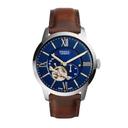
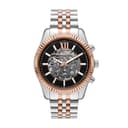
A full skeleton dial removes most of the dial so you see the gear train, the barrel and the balance wheel from the front. It is the most dramatic version and the least legible, because the hands are now moving over a busy metal background instead of a flat colored one. The Townsman and the Lexington are both this.
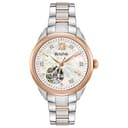
An “open heart” or open aperture keeps the dial and cuts one window in it, usually at 10 or 12 o’clock, so you see only the balance wheel oscillating. It is the better-judged version for most people: you get the mechanical theatre in one small place and the watch still reads like a watch. The Bulova Sutton is this — Bulova publishes the aperture as showing the balance wheel.
An exhibition caseback leaves the dial alone entirely and puts a sapphire or mineral window in the back of the case. The owner sees the whole movement whenever they take the watch off, and the dial stays as readable as any other watch. It is also, by a wide margin, the cheapest way to buy this feature.
The four compared, from the listings and spec sheets
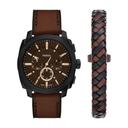
Read the case column before anything else. Two of these four are 44mm and 45mm, which is large by any standard and very large on a wrist under about 6.75 inches. That is not a coincidence: a skeleton dial needs room to be legible at all, so the category skews big. If the recipient has a slim wrist the honest answer is the Bulova Sutton at 34.5mm, and then our small-wrist roundup rather than this page. Our size guide takes two minutes and saves the gift.
Then read the water-resistance column, because it is worse than it looks. None of the four publishes more than 50m, and the Bulova publishes 30m. There is a mechanical reason for that as well as a commercial one: these are dress-leaning watches with display-heavy cases, not tool watches. 50m covers hand-washing and rain; 30m covers less than that, and neither covers a shower. The ladder is in our water-resistance explainer.
The cheaper way to get the same effect
If what the recipient would enjoy is watching the movement work rather than a dramatic-looking dial, the sensible purchase is not on this page. Buy a Seiko 5 with an exhibition caseback instead. Several of the Seiko automatics we track publish a see-through caseback over the 7S26 or 4R36 caliber — so the owner gets the whole movement, visible whenever the watch comes off, with a flat legible dial on the front and, in the 4R36’s case, 100m of water resistance instead of 50.
That combination is usually the cheaper purchase as well, and on every spec that is not “how it looks from the front” it is the better watch. We would not normally spend a paragraph of a roundup telling you to buy something off it, but this is the one category where the obvious product and the right product come apart. The candidates are on best Seiko watches and the framing is on a first automatic watch.
Is a skeleton watch a good gift?
It is an unusually good gift for one specific person and a poor one for everybody else, so it is worth being honest about which you are buying for.
It lands when the recipient has never owned a mechanical watch. The mechanism doing visible work is the part that converts somebody from “a watch tells the time” to “oh, that is a machine”, and a skeleton dial does that in the first ten seconds of opening the box, with no explanation needed from you. For a graduation, an eighteenth, a first proper job, that is worth more than a better spec sheet.
It misses when the recipient needs to read the time quickly — a nurse, a teacher, a trade, anyone glancing at a wrist in poor light. Hands over a moving metal background are genuinely harder to read than hands over a plain dial, and no amount of lume fixes it. Those recipients want an easy-to-read dial instead, and we would rather sell you that than have the gift sit in a drawer.
It also misses with anyone who will not wind or wear it. An automatic winds from wrist movement, so a watch kept in a box stops, and a stopped watch needs setting before it can be worn. That is a minor ritual to an enthusiast and an annoyance to everyone else: setting an automatic and whether automatics need batteries are the two questions we get asked most about them.
The one to skip — and why
Skip the very cheap skeleton watches that dominate marketplace search results for this term. They are the single worst value on any list we write, for a structural reason: a skeleton dial is a cosmetic feature, so it is the cheapest thing a low-end maker can add and the easiest thing to fake. What you get is an unnamed mechanical movement with no published jewel count, no published water resistance and no serviceable parts, under a cut-out dial designed to look busy. The whole appeal of this category is seeing real watchmaking work, and those watches are showing you something that will stop within two years and cannot be repaired for less than its purchase price. If the budget is under $100, buy a quartz watch with a good dial and spend nothing on the mechanism — our under $100 page is full of them.