What you are buying when you buy the knife company’s watch
Two facts, both worth knowing before you spend the money. The first is that the company is genuinely old and genuinely Swiss: it was founded in Ibach, in the canton of Schwyz, in 1884 as Messerfabrik Carl Elsener, and the name Victorinox dates from 1921 — a portmanteau of “Victoria”, for the founder’s mother, and “inox”, from the French acier inoxydable, stainless steel. The I.N.O.X. watch line is named after the second half of that word.
The second is that watches are a licensed business for the company rather than its original trade — Victorinox is the world’s largest maker of pocket knives, and it licenses its logo for watches, apparel and travel gear. That is the same arrangement, in principle, as the one behind the Michael Kors watches we cover, and we said so there too. The difference is what shows up on the spec sheet: every watch on this page publishes Switzerland as its country of origin, a named or at least explicitly Swiss movement, and a warranty term the licensor stands behind. A licensed watch is not automatically a worse watch; it is a reason to read the specification rather than the logo.
The 5-year warranty is the real reason this brand earned a page
We counted. Across the 85 watches in our registry before this page was written, eight published a warranty length in years— the rest publish a brand name and the word “limited”, or nothing at all. All six Victorinox references here publish five years, on Victorinox’s own product page for each item number.
For a gift buyer that matters more than it sounds. You are buying an object you will not be present to look after: if the watch stops in year three, the person you gave it to is the one standing in a jeweler’s shop. A published multi-year warranty from a company that has been in business since the 1880s is the closest thing to a guarantee that the awkward conversation never happens. It is also the only spec on this page that no competitor in our registry can match at any price.
The two specs that decide whether it fits
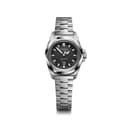
Case size.Five of the six are 41mm or 42mm across and 11mm or 12mm tall. That is a substantial watch — comfortable on an average or larger wrist, and visibly too much on a slim one. Only the I.N.O.X. Small, at 32mm and 9mm, suits a smaller wrist, and it is the one we would buy for a woman or for anyone who has told you their current watch feels big. If you are not sure, our page on watches for small wrists explains how to judge it from a photograph.
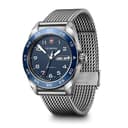
Lug width. This is the spec nobody checks and the one that bites later. Victorinox publishes a 21mm lug widthon all five of the full-size models. Straps are made in even sizes — 20mm and 22mm are everywhere, 21mm is not — so replacing the band is harder than it should be. It is not a reason to avoid the watch; it is a reason to buy the band you actually want on day one, which is part of why the mesh version leads this page. Our guide to changing a strap explains how to read a lug width before you buy.
The picks against the specs
| Pick | Case | Height | Water | Movement | Lugs |
|---|
| Swiss Army Quartz 242042 (mesh) | 42mm | 11mm | 100m | Swiss quartz, Ronda 517 | 21mm |
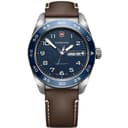
| Swiss Army Quartz 242040 (leather) | 42mm | 11mm | 100m | Swiss quartz, Ronda 517 | 21mm |
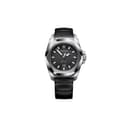
| I.N.O.X. Quartz 242028 | 41mm | 11mm | 200m | Swiss analog quartz | 21mm |
| I.N.O.X. Small 242036 | 32mm | 9mm | 100m | Swiss quartz | 16mm |
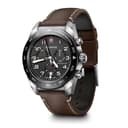
| Swiss Army Chrono 242046 | 42mm | 12mm | 100m | Swiss quartz chronograph, Ronda 5030.D | 21mm |
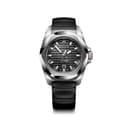
| I.N.O.X. Automatic 242039 | 41mm | 12mm | 200m | Swiss automatic | 21mm |
Every figure in that table is published by Victorinox on the product page for that item number, which is also where each entry above traces its specs to. Read it as a fit chart rather than a ranking: the two I.N.O.X. models are the tough ones at 200m, the Swiss Army pair are the everyday ones, the chronograph is the busiest, and the Small is the only one that will suit a narrow wrist.
What Victorinox does not publish
The crystal.Not on one of the six. Victorinox publishes the case material, the bezel material, the caseback material, the bracelet material, the dial finish and the case finish — and then stops short of the glass over the dial. We have left that field as “Not published” on every entry rather than assume the sapphire the brand is usually credited with, because an unverified spec is worth nothing to you.
It is a genuine gap, because the crystal is the spec that decides how a watch looks in year five — our sapphire versus mineral crystal note sets out why. If that is the thing you care most about, buy a brand that will put it in writing: every Tissot we recommend states sapphire, and so does the Seiko Essentials. On the two calibers Victorinox does name — the Ronda 517 in the Swiss Army Quartz pair and the Ronda 5030.D in the chronograph — the brand is more forthcoming than most of our registry, so the silence on the crystal is a choice rather than a house style.
Where the money sits, honestly
Victorinox starts near the top of our range and goes above it. The cheapest watch here lands in the same bracket as a Tissot PRX, and the automatic is dearer than everything on our under-$500 page — you are into under-$1,000 territory for most of the range. Nothing on this page is a value play, and we are not going to pretend otherwise.
What the money buys, specifically: Swiss assembly, a published multi-year warranty, 100m or 200m water resistance across the board, and a name that needs no explaining at the moment the box is opened. What it does not buy is more watch per dollar — a Seiko at this price is a mechanical watch with a sapphire crystal, which is the argument our Tissot versus Seiko comparison makes at length and which applies here with the brand name swapped.
When another brand is the better gift
- If they follow watches at all, the same money from Seiko or Orient buys a mechanical movement and a spec sheet that holds nothing back. Victorinox is bought for the name and the warranty; an enthusiast is not shopping for either.
- If it has to go under a shirt cuff, 11mm or 12mm of case height and a 42mm dial is the wrong brief. Our dress watch picks are thinner and quieter, which is what a suit actually needs.
- If the budget is the constraint, stop here and read our cheap watches that look expensive page instead. Spending Victorinox money to be safe is a worse outcome than spending a quarter of it well.
- If she wears small, delicate watches, the 32mm I.N.O.X. Small is the only candidate here, and even that is a tool watch in miniature. Our guide to the best watch brands for women sorts the alternatives by what each brand is actually selling.
The one to skip — and why
Skip the Swiss Army Chrono as a first Victorinox, even though it is the most impressive-looking watch on this page. A tachymeter bezel, three sub-dials and a 12mm case buy you a dial that takes a beat longer to read and a stopwatch almost nobody uses twice — and on a leather strap, a sporty complication sits oddly with a dressy band. Buy it only if the recipient has said they like a busy dial. If they have not, the plain Swiss Army Quartz on mesh is the same Swiss watch, the same warranty, one millimeter thinner, and considerably easier to live with. Skip the I.N.O.X. Automatic too unless the watch will be worn most days: a self-winding movement stops after a day or two in a drawer, and the person who alternates between two watches will quietly resent resetting it.