What each format is actually better at
| | Digital | Analog |
|---|
| Reading an exact time | Immediate, to the second | Approximate at a glance |
| Reading elapsed time | Needs a stopwatch mode | Instant — you see the gap on the dial |
| Extra functions | Alarm, stopwatch, timer, backlight, second zone | Date at most, unless it is a chronograph |
| Battery life | Years — one pick here publishes about seven | Typically shorter, and makers rarely publish a figure |
| Entry price in our registry | About $20 | About $45 |
| In the dark | A button lights the whole screen | Luminous hands, if the maker fitted them |
| Reads as a gift | Rarely, unless the recipient wanted that exact watch | Usually |
The row that people get backwards is elapsed time. A digital display tells you it is 4:52; an analog dial shows you that it is eight minutes to the hour, which is a different and often more useful piece of information. It is the reason analog dials survived the digital watch entirely, and the reason cockpit and hospital clocks are still largely analog. If the recipient spends their day working out how long is left rather than what time it is, the analog dial is doing real work for them.
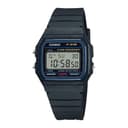
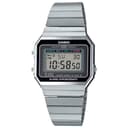
The row that decides most purchases is the last one. A digital watch is a tool and an analog watch is a present. That is not snobbery about the format — a Casio F-91W is one of the most genuinely useful objects anyone can own for $20, and it is on several of our roundups for exactly that reason. But it is bought, not given, unless you know the recipient specifically wanted one. Our is a watch a good gift guide is worth two minutes if that distinction is new to you.
Accuracy and battery life, with the numbers makers actually publish
On accuracy, the practical answer is that both formats here are quartz and both are accurate to within seconds a month — far closer than any mechanical watch. A digital display has one honest edge: it shows the seconds digit, so drift is visible and correctable, where an analog hand has to be reset against something else. If genuine precision is the requirement, the real answer is neither format but a radio-controlled watch that sets itself, and our titanium roundup carries the one we can verify.
On battery life, the comparison is lopsided in a way we can document rather than assert. Of the 96 watches we track, most makers do not publish a battery figure at all — and every one that does is a digital Casio: about seven years for the F-91W, three for the A700, two for the Edifice chronograph. Not one analog reference in our registry publishes a numeric battery life. That is a finding about disclosure as much as about chemistry, and it is covered in full on how long a watch battery lasts. If never thinking about a battery is the goal, the answer is a third option: a solar analog watch, which is light-powered and never has the caseback opened at all — see our solar picks.
The child learning to tell time
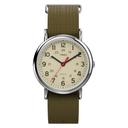
This is the most common reason people search this comparison, and it has a clear answer: analog, with numerals at every hour. A digital watch removes the skill rather than teaching it. What matters is not the format label but three specifics — every hour printed as a numeral rather than a baton, a clear minute track around the edge, and hands in contrasting colors. The Timex Easy Reader above is on this page for precisely that: it is a legibility specification rather than a style. Our easy-to-read roundup goes further into what makes a dial readable, and watch gifts for kids covers the age question.
The exception is an older child or teenager who wants a digital watch, in which case buy the digital watch. A gift they asked for beats a gift that teaches them something, and the exam-hall point is worth knowing either way: an analog watch is still permitted in many exam rooms where a phone and a smartwatch are not, though institutions differ and the course handbook is the authority. Our student picks cover that properly.
If they want both in one watch
A large share of the searches behind this page are not a comparison at all — they are people looking for a watch with an analog dial and a digital window, the layout usually called ana-digi. We cannot help with that honestly: there is no ana-digi watch in our registry. We have not found one at gift prices whose maker publishes a full spec sheet we can verify, so rather than point you at a listing we have not read, here is the straight advice: that layout is a Casio and Seiko specialty, the G-Shock and Edifice lines are where to look, and the thing to check before buying is which of the two displays is actually readable at a glance — on many ana-digi dials the hands cover the window. If a tough digital Casio is close enough, our digital roundup has the ones we can stand behind.
Which to buy, by recipient
- Buy digital for someone who will use the functions — a nurse timing something, a runner, a tradesperson, a teenager who asked for one — or where the watch will take a beating. Our nurse and construction pages lean digital for those reasons.
- Buy analog when the watch is the gift rather than the tool, when it will be worn with a shirt cuff, or when the recipient is learning to read a dial. Nearly every page on this site is an analog recommendation, which is itself an answer.
- Buy a solar analog if the honest reason you are drawn to digital is “it never needs anything”. That is the real requirement, and a light-powered analog watch meets it without giving up the object.
- Buy neither if what they want is notifications and a step count. That is a smartwatch, it has a two-to-three year life, and we say so plainly on watch versus smartwatch.
One last note on the format war that never happened: digital watches did not replace analog ones, and analog watches did not kill digital. Both have been sold side by side for fifty years because they answer different questions, and the cheapest watch in our registry and one of the most useful are both digital while almost everything we recommend as a gift is not. Holding both of those facts at once is the whole content of this page.