The ten-second test
Before you compare a single specification, answer this: what color is the metal already on that person? You almost certainly know, because you have seen their hands a hundred times.
- Mostly yellow gold — a gold wedding band, gold studs, a gold chain. Buy gold-tone. A steel watch beside a gold ring looks like it was chosen by someone who was not paying attention.
- Mostly silver, white gold or platinum — buy steel. This is the majority of people, which is part of why steel is the default.
- Both, or no jewelry at all — buy steel, or buy two-tone deliberately. A watch is the one accessory where mixing is normal, but it only reads as a choice when the watch itself contains both metals.
- Rose gold — a separate decision with its own answer, and we keep it on its own page: rose gold watches. It is warmer than yellow gold and matches the copper-toned jewelry a lot of people have bought over the last decade.
One more input worth two seconds of thought: what they wear on their wrist is more visible than what is on the dial. If the recipient wears a gold bracelet on the same arm, the watch will touch it all day. Match it, or move the watch to the other wrist — which our guide to which wrist to wear a watch on covers properly.
The three pairs, from the published spec sheets
| Pick | Finish | Case | Movement | Crystal | Water resistance |
|---|
| Citizen Addysen Eco-Drive BM7252-51E | Gold-tone | 41mm, men’s | Eco-Drive solar (E111) | Sapphire | 100m |
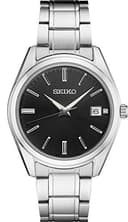
| Seiko Essentials SUR311 | Steel | 40.2mm, men’s | Quartz (6N52) | Sapphire | 100m |
| Citizen Peyten Eco-Drive EO1222-50P | Gold-tone | 33mm, women’s | Eco-Drive solar (E111) | Sapphire | 100m |
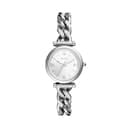
| Fossil Carlie | Steel | 28mm, women’s | Quartz | Mineral | 50m |
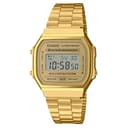
| Casio Vintage A168 Gold-Tone | Gold-tone | 36mm, unisex | Digital quartz | Acrylic | Splash only |
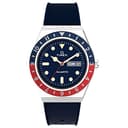
| Timex Q Reissue 38mm | Steel | 38mm, unisex | Quartz | Acrylic | 50m |
The top pair is the useful one, because almost nothing else differs. The Citizen Addysen and the Seiko Essentials are both about 40mm, both sapphire, both rated to 100m, and both sit in the same price band — so a buyer choosing between them is choosing a color and nothing else. The one real specification difference runs in gold’s favor here: the Citizen is solar, so it never needs a battery, which our Eco-Drive versus quartz page argues is the single most gift-friendly feature in this price range.
The bottom pair is where we have to be honest. At the cheapest end, gold-tone in our registry is digital Casio. The A168 is a genuine icon and a lovely cheap present, but it is a splash-only digital watch, and the silver side at that price has a 50m analog Timex. That is not a coincidence — it is the shape of the market, which the finding further down this page spells out.
What “gold-tone” actually means
Every gold watch on this site, and essentially every gold watch at gift prices anywhere, is gold-tone: a color, not a metal. The case and bracelet are stainless steel with a gold-colored finish on top. That is not a criticism and it is not deceptive — it is how the entire category works below several thousand dollars — but it is worth understanding before you spend.
The words have legal meanings. A seller may only say “gold electroplate” when the plating is a karat-graded gold layer of at least 0.175 microns, and “heavy gold electroplate” at 2.5 microns — the FTC’s jewelry guides set those floors specifically so that “reasonable durability is assured”. The jewelry trade grades the same thing by thickness: “gold flashed” or “gold washed” is under half a micron, “gold plated” is half a micron or more, and vermeil is 2.5 microns or more. The thickness is what decides how long the color lasts in use.
“Gold-tone” is none of those. It is a color word, and a watch described that way is making no claim about gold content at all — the finish may be an electroplate, or it may be a physical vapor deposition coating, which on gold-colored hardware is often titanium nitride, a ceramic hard enough to be used on machine tooling. None of the gold-tone listings we track publishes which process it used or how thick the layer is, and we are not going to guess on their behalf. What that means practically:
- A gold-tone finish can wear through; steel cannot. Wear shows first on the clasp, the bracelet edges and the case corners — the places that rub. A brushed steel bracelet picks up scratches instead, which is a cosmetic change rather than a color change, and it polishes out.
- A PVD-coated gold-tone case is genuinely hard and may outlast the plain steel beside it. The problem is you usually cannot tell which one you are buying from the listing.
- Plated jewelry normally carries a nickel barrier layer under the gold. If the recipient reacts to inexpensive jewelry, that is worth knowing: the standard advice for nickel contact dermatitis is to avoid prolonged skin contact with nickel-releasing metal, and the answer in watches is usually titanium, which no gold-tone watch in this price range is.
Our gold watch roundup goes through the full set of gold-tone picks with the same disclosure on each. If what you actually want is a solid gold watch, that is a different purchase at a different price and this is not the site for it.
Suits, weddings and the two rules worth keeping
Most “rules” about watch metals are invented. Two are not, and both are easy.
One: match the watch to the other hardware, not to the clothes. With a black suit and black shoes, the belt buckle and cufflinks are usually silver, so a steel watch is the quiet choice and a gold one deliberately is not. With brown shoes, a tan or brown belt and a navy suit, gold sits comfortably. For a tuxedo the convention is the plainest, thinnest watch the person owns in whichever metal matches their cufflinks — and plenty of people take the watch off entirely. Our guide to what watch to wear with a suit is the longer version.
Two: at a wedding, match the ring. If the groom’s band is yellow gold, a gold watch is the correct gift and a steel one fights it; if the band is platinum or white gold, steel. This is the single most reliable metal decision on this page, and it is why wedding, groomsmen and father-of-the-bride gifts are the easiest metal calls you will make.
Can you mix metals? Yes — but do it on purpose
“Can I wear a silver watch with gold jewelry” is one of the most common forms of this question, and the honest answer is that the old rule against mixing metals has been dead for years. Mixed metals read as intentional when there is a second mixed element in the outfit, and as an accident when the watch is the only one. That is the whole trick. A steel watch beside a gold bracelet looks deliberate if there is a two-tone necklace or a gold-and-steel ring in the picture, and looks like a mistake if there is not.
Which is exactly why two-tone exists, and why it is the right gift more often than people expect. A two-tone bracelet contains both metals, so it sits correctly beside gold jewelry and silver jewelry without needing anything else to justify it. If you have read this far and still cannot tell which metal the recipient wears, stop here and buy two-tone instead of flipping a coin — our two-tone roundup is built entirely around that reasoning, and the Citizen Corso in it is the same Eco-Drive family as the gold pick above.
The finding: the market makes five times more silver than gold
Here is the most useful thing our own registry can tell you about this question. Of the 96 watches we track, 6 are gold-tone, 4 are rose gold-tone and 6 are two-tone — 16 in total. The other 80 are steel, black or titanium. We did not set out to build it that way; that is what is available and in stock at these prices.
Two consequences follow, and both matter more than any style rule:
- Choosing gold narrows the field hard. At any given budget you will have a handful of options in gold-tone and dozens in steel, so the steel watch you can buy for $200 is usually a better watch than the gold-tone one at the same price. The exception on this page is the Citizen Addysen, which is why it is the gold pick.
- Gold-tone skews toward women’s and toward dress watches. If you want a gold-tone field watch, a gold-tone diver or a gold-tone chronograph at gift prices, you will mostly be looking at fashion brands rather than watch brands. That is a trade worth making consciously — our Michael Kors page is honest about what you give up.
The one to skip — and why
Skip anything that calls itself “18K gold” or “solid gold” at a gift price. A listing using a karat number on a $60 watch is either describing a plating in words the FTC reserves for something else, or it is not describing the watch at all — and either way the figure is unverifiable from a product page. Skip heavy, bright, mirror-polished gold-tone bracelets if you are buying for someone whose taste you cannot read: polished gold is the single most opinionated finish in watches, it photographs far better than it wears, and it is the most common reason a generous watch gift quietly never gets worn. A brushed or satin gold-tone finish is the safer version of the same idea. And skip the skin-tone charts. If you have access to one photograph of the recipient’s hands, that is better evidence than any undertone theory.
If the finish is the only thing you are unsure about
Then you are closer to done than you think, because the finish is the easiest thing on a watch to get right and the hardest to argue about afterwards. Match the jewelry, default to steel, and hedge with two-tone. Then spend your remaining attention on the two things people actually get wrong: the case size against their wrist and the band, metal or leather — and if the answer there is metal but you cannot measure the wrist, a mesh band solves it outright.