The two clasps that size themselves, and why that matters for a gift
If you cannot measure the recipient’s wrist — which is the normal situation, because asking gives the surprise away — the clasp is the most important thing on the whole watch.
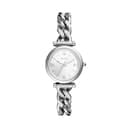
The Fossil Carlie publishes an “Adjust-O-Matic” clasp, which Fossil describes as tool-free: the wearer sets the length themselves without removing links. On a women’s watch that is the single most useful feature on this page, because a 12mm bracelet on a 28mm case is the hardest kind to get resized cheaply. The Victorinox I.N.O.X. Small, on our Swiss list, publishes a butterfly clasp, which is a different mechanism but also adjusts within a range by hand. Everything else here has removable links.
The other way around the problem is to not buy a link bracelet at all. A mesh band slides and locks anywhere along its weave, so it fits any wrist in its range in about fifteen seconds, and a leather strap has buckle holes. We have written the whole fork out at leather versus metal watch band, using a single Victorinox reference sold on both so nothing but the band changes.
The eight compared, from the published spec sheets
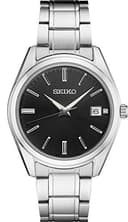
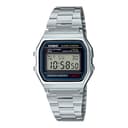
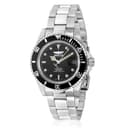
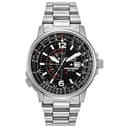
One thing in that table is doing more work than it looks. Three of the eight publish 100m and two publish 200m, and that is the real argument for a steel bracelet over any other band: a leather strap is a consumable that sweat and water destroy, and a steel bracelet simply is not. If the recipient never takes a watch off, this is the band type to buy, and the case rating is what decides whether the watch underneath can keep up.
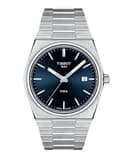
The Tissot PRX is the outlier and worth understanding. Its bracelet is integrated, meaning the links flow straight out of the case with no lugs and no spring bars, so the design reads as one object. It is the single most expensive-looking watch in our registry for that reason. The cost is that you cannot ever change the band: no leather strap, no mesh, no NATO. Our PRX alternatives page works through what else gets you that look.
What steel bracelets are genuinely bad at
We would rather you know before you buy. They pull arm hair, and a cheap one pinches. A well-finished bracelet has close tolerances between the links; a poorly finished one has gaps that catch skin. This is the one quality difference you can feel on day one and cannot see in a photograph, and it is most of what separates a well-made bracelet from a cheap one.
They are heavy. A steel bracelet can account for well over half a watch’s weight, and the Victorinox references we track are a third lighter on leather than on metal. For someone who has never worn a watch, weight is the most common reason the gift gets taken off and not put back on. If that is the risk, titanium is about half the density of steel and solves it properly.
They sit directly against a lot of skin, which matters for nickel. Stainless steel contains nickel, and nickel contact dermatitis is the most common contact allergy there is; the standard advice is to avoid prolonged contact with nickel-releasing metal. A bracelet is the worst band type for that and a strap is the best. Our sensitive-skin guide has the alternatives.
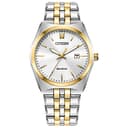
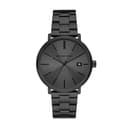
And two-tone is plating on steel, not gold. Two of the picks above are two-tone or black-coated, which is a colored finish over the same steel. The jewelry trade grades platings in microns and the thickness is what decides how long the color lasts; neither listing publishes one, so we say so. The full version is on gold versus silver and two-tone watches.
The one to skip — and why
Skip hollow-link bracelets, and the way to spot one without handling the watch is the weight in the listing plus the price. A hollow link is folded sheet steel rather than a solid block; it rattles, it flexes, and the pin holes wear oval so the bracelet eventually will not hold a pin at all. It is the standard construction at the cheap end of the market and it is the reason a cheap steel bracelet feels cheap in a way a cheap leather strap does not. Skip, too, any steel bracelet whose listing will not say whether it is held together by pins or by screws — that is the difference between a resize you can do at a kitchen table and one you cannot — and skip an expansion or “stretch” bracelet for anyone who is not buying it for nostalgia. They need no sizing at all, which is their one virtue, and they catch skin, collect grit and stretch permanently out of shape.