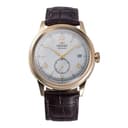
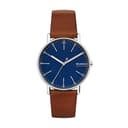
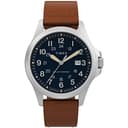
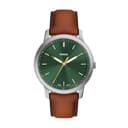
Why leather, in order of how much it matters
- It fits without a jeweler. Buckle, holes, done. No links, no tool, no appointment, no guessing a wrist size from a photograph. Our band resizing guide explains what the alternative involves.
- It is lighter and warmer against the skin. A leather strap weighs a fraction of a steel bracelet, does not pull hair, and does not conduct cold the way metal does in winter. For anyone who has never worn a watch regularly, leather is the easier thing to get used to.
- It dresses a watch up.The same case reads formal on dark leather and casual on a bracelet — which is most of why what to wear with a suit lands on leather almost every time.
- It is cheap to change.A strap is a consumable. When it wears out, or when the recipient decides they want black instead of brown, it is a five-minute job — see how to change a watch strap. That also makes a spare strap a genuinely good second gift.
The one thing leather cannot do
Get wet. Repeatedly wetting a leather strap breaks down the fibres and the adhesive, and the result is stiff, discoloured and unpleasant within a season. This has nothing to do with the watch’s water-resistance rating: the Tissot Everytime on this page is rated 30m and the Timex Expedition North is rated 100m, and the strap is the weak link on both.
Two practical answers. If the recipient swims or showers in their watch, buy the Timex Expedition North— its listing publishes an Ecco DriTan leather strap on quick-release spring bars, so the strap pops off by hand and can be swapped for something waterproof in seconds. Or buy any watch here and add a second strap, which is what our watch and strap pairing page is about.
Lug width: the measurement that decides the replacement
A strap fits a given lug width— the gap between the two horns that hold it, measured in millimetres. Get it wrong and the strap either will not go in or rattles. Four picks here publish theirs, which is unusually generous and worth recording:
| Pick | Published lug width | Strap as sold |
|---|
| Fossil Minimalist FS6094 | 22mm | Brown genuine leather, buckle |
| Skagen Signatur SKW6355 | 20mm | Brown genuine leather, single-prong buckle |
| Timex Expedition North | 20mm | Ecco DriTan leather, quick-release bars |
| Timex Easy Reader 38mm | 20mm | Brown leather, buckle |
The others publish the strap material but not the width, which means measuring the old strap before buying a new one. We do not recommend a specific aftermarket strap anywhere on this site, for the same reason we do not recommend anything else we have not verified: we hold no verified replacement strap listing, so naming one would be a guess.
What “genuine leather” does and does not promise
It is a material claim, not a quality one. Three picks here publish “genuine leather” in their own specifications and one publishes a croc-embossed finish, which means leather stamped with a pattern rather than crocodile. None of them publishes a tannage, a thickness or an origin, and we are not going to infer one. What you can tell from a listing photo is the stitching and the edge finish — a folded, painted edge lasts longer than a raw cut one — and what you can tell from the price is roughly how much of the budget went into the strap rather than the watch.
The useful consequence: on a cheap watch, assume the strap is the cheapest part and plan to replace it eventually. That is not a criticism. It is why a leather watch stays wearable for a decade while a cheap bracelet watch does not.
The one to skip — and why
Skip the Tissot PRX, and any other watch with an integrated bracelet, if what you want is leather — we recommend the PRX warmly elsewhere and it simply cannot take a strap, because the bracelet is shaped into the case rather than fitted between lugs. Skip leather altogether for a nurse, a chef, a tradesperson or anyone who washes their hands twenty times a day: it will be ruined inside a year and there is no technique that prevents it. Buy resin, polyurethane or mesh for that wrist instead.