The numbers each metal publishes
| | Titanium | Stainless steel |
|---|
| Density | 4.502 g/cm³ | 7.5–8.0 g/cm³ |
| Hardness (bare metal) | Mohs 6.0 | Not published as a single figure — alloy dependent |
| What it is made of | Titanium, or an alloy of it | Iron plus 10.5%+ chromium; 316L adds 10–12% nickel and 2–3% molybdenum |
| Corrosion | Resists sea water and chlorine | Chromium oxide layer; 316L is used in marine applications |
| Skin | One of the most biocompatible metals; used for implants | Nickel content is the usual cause of a watch rash |
| What it costs on this site | From just under $300 | From about $20 |
That last row is the one buyers underestimate. Steel does not have a price floor and titanium does. Our registry carries verified steel watches from about $20 upward; the cheapest titanium reference we could verify as a real, in-stock watch with a published spec sheet opens just under $300. Between those two numbers, the comparison is not titanium versus steel at all — it is titanium versus a much better steel watch.
Weight: what “half” actually feels like
It feels like less than you expect at the first try-on and more than you expect by the end of the day. That is the honest version, and it is why we are careful about who should pay for it. A watch head is a small object; halving the mass of a small object is not a dramatic moment in a shop. What changes is the eight hours afterwards — the bracelet does not slide down the wrist under its own weight, the watch does not swing when the arm moves, and a 44mm case stops being a commitment.
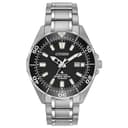
Two practical consequences. First, the weight saving lives in the bracelet, not the case. If the watch is going on leather, the mass you remove is only the case, and the premium is much harder to justify — that is why our titanium page puts the full-bracelet reference alongside the leather ones rather than above them. Second, titanium is how you give someone a big watch. A titanium 44mm diver is wearable all day by people for whom a steel 44mm diver is not, which is the only reason to consider the Promaster in titanium over the same model in steel. Our big-wrist roundup and the size guide both have the measurement to take first.
Scratches: the question everyone asks
The honest position is that we have not handled these watches, so we are not going to assert a hardness result as our own finding. What we can do is tell you what is published and what the market does about it.
Bare titanium’s Mohs hardness is 6.0. Stainless steel is not published as a single comparable figure because it depends entirely on the alloy and its heat treatment. The useful evidence is behavioral: Citizen developed a proprietary surface-hardening treatment, DURATECT, specifically for its titanium range and markets the result as more than five times harder than stainless steel, at nearly half the weight
, quoting roughly 1,000 to 1,100 HV for some variants. Those are Citizen’s claims, reported as Citizen’s claims. But nobody develops and brands a hardening process for a metal that was already hard enough, which tells you what the untreated version is like — and it also means that “titanium scratches easily” is a statement about bare titanium, not about the treated titanium you are actually buying.
The more useful reframing: the part of a watch that shows scratches is the crystal, not the case. Scratches on a case catch the light at an angle. Scratches on the glass sit directly over the dial where they are read every time. If the complaint you are solving is scratches, the spec to buy is a sapphire crystal — in either metal — and our sapphire versus mineral guide explains why that is the cheaper fix.
Nickel, and the only claim we will make about skin
This is where titanium earns its reputation, and it is worth being precise. A mark under a watch is usually nickel — nickel allergic contact dermatitis — and austenitic stainless steel contains a lot of nickel. 316L, the grade watch brands name when they name one at all, is 10 to 12% nickel by composition. Titanium, by contrast, is described in the reference literature as one of the most biocompatible metals and is used for orthopedic, dental and surgical implants.
We still will not call any watch hypoallergenic, and the reason is a finding rather than caution: of the 96 watches in our registry, not one listing publishes a nickel content, a steel grade or a plating method. Citizen does say on its own technology page that Super Titanium helps protect against metal and nickel allergies
; that is Citizen’s claim about Citizen’s material, not ours about a category.
And before you spend $300 on metallurgy, two of the most common causes of a mark under a watch are not allergies at all: moisture trapped under a band worn too tight, and soap left in a bracelet. Both are free to fix, and both are in our sensitive-skin guide, which is the page to read before this one if skin is the reason you are here.
What the same money buys on each side
This is the comparison that decides most purchases, so here it is at the one price point where both metals are genuinely available. At roughly $300:
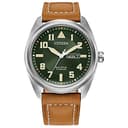
- In titanium you get a 42mm Citizen Super Titanium case, a sapphire crystal, a light-powered movement, 100m water resistance and a five-year published warranty — on a leather strap.
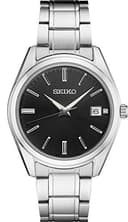
- In steel the same money buys a 40mm Seiko Essentials with a sapphire crystal, 100m water resistance and a steel bracelet, or gets you within reach of a Tissot PRX — a Swiss watch with an integrated steel bracelet and a sapphire crystal.
Read that as the trade it is: the titanium option spends its budget on the metal, and the steel option spends it on the watch. Neither is wrong. It depends entirely on whether the metal is solving a problem the wearer actually has. Our under-$300 roundup has the wider field at this price, and our titanium roundup has the full titanium shortlist with every published spec.
Which to buy, in one line each
- Buy titanium if they take their watch off during the day, if a bracelet leaves a mark, or if you want to give them a 43–44mm watch they will actually wear.
- Buy steel if the budget is the constraint, if they want a mechanical watch (there is no mechanical titanium reference we can verify at these prices), or if what they actually want is a specific watch that happens to be made of steel.
- Buy neither on the strength of the metal alone. Case material is the fourth most important thing about a gift watch, behind size, band and movement. Our five-step chooser puts them in order.
Two things neither metal fixes
Water resistance is a seal, not a metal. A titanium case rated to 30m is no more swimmable than a steel one rated to 30m. The rating comes from the gaskets, the caseback and the crown, and our water-resistance guide explains why a 30m watch should not go in a shower whatever it is made of.
Color is not a metal either. A gold-tone or rose gold-tone finish is a coating applied over steel, and it does not become titanium or stop being steel underneath — which is also why there is no two-tone titanium watch in our registry. If warm metal is the requirement rather than light weight, our two-tone picks are the honest place to look instead.