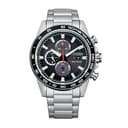
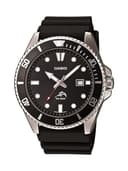
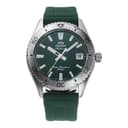
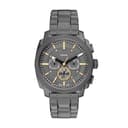
What counts as a big wrist
A wrist over about 7.5 inches around — roughly 19cm — is the point where standard watch sizing starts working against you in the other direction. The table on our watch size guide puts 7 to 7.5 inches at 40–42mm and over 7.5 inches at 42–46mm, and that is the range this page works in.
Worth saying plainly: this is a measurement, not a gender and not a body type. Wrist circumference follows frame and bone as much as anything else, which is why a slim, tall person can need 44mm and someone much broader can be happiest at 40mm. If you cannot get a tape measure anywhere near the wrist, there is a shortcut that works nearly as well — look at a watch they already wear. If a 40mm watch looks small on them, or the bracelet on it is let out to its last link, you are on the right page.
Diameter gets you close; proportion is what you are buying
Case diameter is the number every maker publishes, so it is the number on every card here. It is not the whole of how a watch wears, and on a large wrist two other measurements decide whether a big watch looks deliberate:
- How far the lugs reach. The lugs are the horns the band attaches to, and the span across them is what decides overhang. On a large wrist you have room for that span, which is the real reason a 44mm watch can look right here and silly elsewhere. The check needs no numbers: looked at from above, the lugs should sit inside the flat top of the wrist.
- How thick it is. A wide, flat watch wears far better than a wide, tall one, and it is the difference between a watch that slides under a shirt cuff and one that catches on it every time. Our size guide puts dress watches at roughly 7–10mm and dive watches at 13mm and up, which is worth knowing before you buy a 45mm diver for someone who wears a jacket all day.
- How much of the face is dial. A wide dial inside a thin bezel makes a big case look intentional; a narrow dial ringed by a fat bezel makes the same case look like a cheap watch pretending. That is most of the difference between the picks here and the “big face” watches filling the same search results.
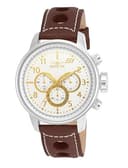
We publish the numbers the maker publishes and nothing else. Diameter is on every card; thickness and weight appear only where the listing states them — the 48mm Invicta here is one of the few that does, at 48 x 13.5mm and a stated 100 grams. Where a spec is not published, the card says so rather than guessing, and how we pick sets out why that matters more than a complete-looking table.
On a large wrist, the band is the part that fails
This is the difference between buying for yourself and buying for someone else. For yourself, a bracelet that is slightly short is a conversation with a jeweler. As a gift, it is the watch going back in the box. The three band types are not equal here, and the ranking is the reverse of the one on our small-wrist page:
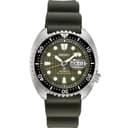
- Resin and silicone straps. The safest band on a large wrist. They are usually the longest thing in the box, they carry a generous run of holes, and a replacement costs very little if the range still falls short. The 44mm Casio Duro and the 45mm Seiko Turtle here both come this way.
- Leather straps with a buckle. Adjustable across their holes, and — the useful part — the cheapest component of a watch to swap. Both leather picks here are on a 22mm band, a common width, so a longer strap in the same size is an easy fix rather than a special order. Our strap guide covers the options, and a one-piece slip-through band is the most forgiving of the lot.
- Steel bracelets. The nicest to wear and the riskiest to give. A bracelet ships with a set number of links: taking links out is a five-minute job with the right tool, which our guide to resizing a watch band walks through, but adding length means sourcing links for that exact reference, and not every watch shop can do that on the spot. Five of these nine picks are on bracelets because they are the right watches; just check the fit before you wrap one.
No listing behind any pick on this page publishes a maximum wrist size, so we do not print one — and you should treat anyone who does with some suspicion. The two-minute check that beats every published figure: measure a band the person already wears, end to end, while they are not looking. Buy against that number and the surprise survives.
Weight, and why size is not the same as heft
A large steel case on a steel bracelet is a heavy object, and weight is the spec that decides whether a watch gets worn at a keyboard all day or quietly stays in the drawer. It is also the spec listings least often publish. Among these nine picks the only stated figure belongs to the 48mm Invicta, at 100 grams — and it is the biggest case here precisely because it is on a leather strap rather than a bracelet. Diameter and heft are separate questions, and the band is usually where the difference lives. For everything else on this page we publish no weight, because the maker does not.
What changes as the price climbs
The nine picks cover a wide span, and the differences are worth knowing before you decide how much to spend:
- Around $55 to $100 buys genuine wrist presence and modest specs — a 48mm quartz chronograph on leather, a 38mm rose-gold-tone watch rated to 100m, and the outlier of the whole page: a real 200m dive watch with a rotating bezel for about the price of dinner for two.
- Around $100 to $250 is the sweet spot for this brief. It buys design that holds up — an industrial 45mm chronograph, or a clean 44mm three-hander on leather — or the solar chronograph that is our overall pick: rated to 100m and with no battery to replace.
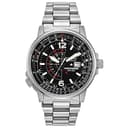
- Above $250 buys the specs that outlast the trend: a true 200m automatic diver with an in-house movement, a light-powered pilot watch with a working slide-rule bezel, or the 45mm Seiko Turtle, an ISO-rated automatic enthusiasts have collected for decades. The automatic here is also the one exception to the page’s size rule, at 41.8mm rather than 42mm and up — the pick if a true 200m mechanical diver matters more than the last couple of millimetres.
Note what does not improve with price: size. The 48mm Invicta is among the cheapest watches on this page, and the most expensive pick here is 3mm smaller than it. Spending more buys the movement, the crystal and the water resistance — never a better fit. Our value hub walks the same ladder for watches of every kind.
Styles that carry a large wrist — and the one that fights it
Dive watches are the natural answer, because they are big for a reason rather than for effect: a rotating bezel and real water resistance need the room, so the size is structural. Chronographs are the second answer, because sub-dials need diameter to stay legible — on a small wrist that is a compromise, and here it is simply the right amount of watch. Pilot watches belong in the same group: a dense, purposeful dial has somewhere to go.
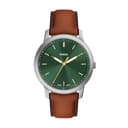
Field watches are the honest disappointment. The style descends from military watches deliberately made small, so most of the good ones sit at 38mm and will look neat rather than right. And dress watches are the real trade-off: a proper dress watch is slim and modest by design, so a 44mm case sold as one is a big-face quartz watch with a plain dial, not a dress watch. If the gift is for a suit, the truthful advice is 40 to 42mm and thin, whatever the wrist measures. If it is for everything else, the 44mm minimalist pick here does the job — Fossil markets that line as “big face” and means it.
If you are buying for a woman with a larger wrist
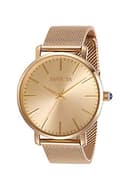
Women’s watches usually run 26–34mm, which is a marketing decision rather than a fit one, and it leaves a real gap. The largest watch we carry from a women’s line is the 38mm Invicta Angel above, rose gold tone throughout and rated to 100m — the pick if the look should stay recognizably a women’s watch.
Beyond that, buy across the label. A 40 to 42mm watch from the men’s or unisex side of any catalog is the same object with different marketing, and on a wrist over 7 inches it will be better proportioned than almost anything in the women’s section. Our watch gifts for women page prints the case size on every pick, so you can shop by the number instead of the label.
The one to skip — and why
Skip buying on diameter alone. The 48mm Invicta on this page is here because it is well proportioned for its size, light for its size and honest about what it is — but 48mm is a lot of watch, and “bigger” stops being better the moment the lugs reach past the flat of the wrist. Skip any 44mm watch being sold to you as a dress watch for a suit; the category and the size genuinely conflict, and a slimmer 40–42mm watch is the better gift. And skip a steel bracelet if you have no way to check the fit before you hand it over — the resin, silicone and leather picks here reach further and cost less to fix, which is worth more on the day than a nicer band.