What makes a watch land with an engineer
There is a useful test for this gift, and it is not a price. Can the recipient do something with it? Four kinds of watch pass:
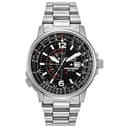
- An instrument.A watch with a function you operate. The Citizen Nighthawk’s slide-rule bezel is the clearest example on this page: rotate the outer ring against the inner scale and it multiplies, divides and converts units. It was designed so a pilot could do fuel burn arithmetic without a calculator, and it still works for anything with a ratio in it.
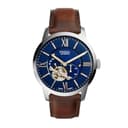
- A mechanism on display.The Fossil Townsman Automatic’s skeleton dial leaves the movement visible, winding itself from wrist motion. For the price of a nice dinner, the recipient gets to watch a mechanical escapement work. That is a disproportionately good gift for someone who likes to see how things are made.
- A ritual. The Hamilton Khaki Field Mechanical is hand-wound — there is no automatic rotor and no battery, so it stops unless the owner winds it. Hamilton publishes roughly an 80-hour reserve from the H-50 movement, which is unusually generous. Plenty of people find a daily wind irritating; the kind of person who enjoys maintaining things finds it the best part.
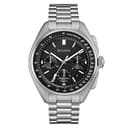
- A story that checks out.The Bulova Lunar Pilot’s design descends from the chronograph a Bulova-powered movement wore on Apollo 15 in 1971. That is a real piece of history, not marketing, and it comes with a high-performance quartz movement and a sapphire crystal.
What fails the test, reliably, is a watch whose only argument is its brand. An engineer will cheerfully tell you what a fashion watch costs to make. If the recipient would actually like a designer name, that is a different and perfectly legitimate gift — buy from our Michael Kors picks and ignore this page.
Quartz is not the boring answer here
It is tempting to assume an engineer must want a mechanical watch. Often they want the opposite, and for a defensible reason: a quartz movement is dramatically more accurate than a mechanical one, and accuracy is the thing a watch is actually for. A mechanical watch drifts seconds a day; a good quartz watch drifts seconds a month.
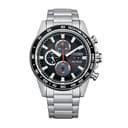
Two picks here lean into that. The Bulova Lunar Pilot uses Bulova’s high-performance quartz, which is exceptionally accurate for a chronograph. The Citizen Nighthawk and the Citizen Brycen use Eco-Drive, which converts light into stored energy and therefore never needs a battery either — arguably the most elegant engineering answer on this page, because it removes a maintenance task rather than adding a pleasurable one. Our Eco-Drive versus ordinary quartz comparison explains what that difference is worth.
So the honest guidance is: buy mechanical if the recipient likes interacting with objects, and solar quartz if they like things that just work. Both are engineering preferences. Neither is the beginner answer.
The F-91W is on this list for a reason
The cheapest pick here is a $20-ish resin Casio, and it is not a joke entry. The F-91W has been in continuous production since 1989, is one of the best-selling watches ever made, and its listing states a battery life of around seven years. It weighs almost nothing, has an alarm and a stopwatch, and is the watch you see in labs, workshops and server rooms more than any other.
It is also the single best demonstration of a point engineers enjoy: the cheapest object on the page keeps better time than the most expensive mechanical one. If you are buying a small gift, or a second gift to go alongside something else, it is almost impossible to get wrong. The one thing to know is that Casio rates it splash-resistant only — it is not a watch for washing up in, let alone swimming.
Which discipline, and does it change the answer?
A little. Mechanical and manufacturing engineersget the most out of the two mechanical picks — the hand-wound Hamilton and the skeleton-dial Fossil — because the thing they are being given is a working assembly of parts. Aerospace, aeronautical and marine engineersare the natural audience for the Nighthawk’s slide rule and for the Lunar Pilot’s Apollo lineage. Electrical and software engineers split: some want the mechanism, many want the F-91W and a clear conscience.
Civil and site engineers are the exception worth flagging, because their watch has a harder life than the others. If the recipient is on site rather than at a desk, the shock and water requirements take over and our picks for a construction worker are the better list. And for an engineering student — a graduation gift, typically — the Fossil Townsman Automatic is the sweet spot: a real mechanical watch, on display, at a price that suits someone who has not started earning yet. Our graduation watch picks cover the rest of that occasion.
Size, because it is the one thing you can get wrong
Two of these are big. The Bulova Lunar Pilot is 45mm and the Nighthawk is 42mm with a dense, busy dial, so both need a wrist that can carry them. The Hamilton Khaki Field is 38mm and will suit almost anyone. If you have no idea what they wear, measure before you buy — our watch size guide takes two minutes, and our small-wrist picks are the better starting point for a narrow wrist.
The one to skip — and why
Skip the Hamilton Khaki Field Mechanical for someone who wears a watch occasionally. A hand-wound watch with no rotor and no battery is dead every time it is picked up after two or three days, and has to be wound and reset before it is useful. For a person who enjoys that, it is the best watch here. For someone who wears a watch twice a month, it becomes an object of guilt — buy them the solar Citizen instead. Skip the Lunar Pilot unless you know they like large watches; 45mm is a lot, and 50m water resistance is the weakest rating on this page, so it is not the one to wear into a pool.