The spec order, and why it is this order
On every other recipient page on this site, style comes first. Here it comes fifth, and the reason is that a watch on a working wrist fails in a predictable sequence.
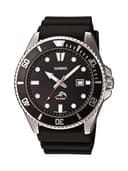
- Shock first.A watch does not usually die from one heroic impact; it dies from a thousand knocks against scaffolding, door frames and the inside of a van. Casio’s shock-resistant construction is the only thing on this page designed specifically for that, which is why the DW5600 leads it.
- Water second, and overbuy it.Water-resistance ratings are a static-pressure measurement, not a promise about real life — see what the ratings actually allow. A 30m watch is a splash rating; a 50m watch is fine in rain. For hands that get hosed down, go to 100m or 200m and stop thinking about it. Four of these six are rated 200m.
- The band third. Resin and polyurethane wipe clean and dry out. A steel bracelet traps grit in every link and catches on things, which on a site is a safety point as much as a comfort one. Leather and fabric absorb whatever they are standing in.
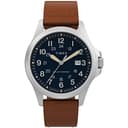
- The crystal fourth.Mineral glass resists scratches better than acrylic and shatters more readily; acrylic scuffs but can be polished and absorbs a blow. Sapphire is the most scratch-resistant of the three — our sapphire versus mineral note explains the trade. Only the Timex Expedition North here has it.
- Then looks. Which, happily, is not much of a sacrifice: the classic diver and field shapes on this page are the most-copied designs in watchmaking because they look good.
Digital or analog?
This is the real fork in the decision and it is worth asking before you buy. A digitalwatch gives you a timer, a stopwatch, an alarm and a backlight, which matter if the work is timed — curing, setting, firing, baking, a billed hour. It also reads at a glance in the dark with a gloved hand. That is the Casio DW5600 and the Timex Ironman.
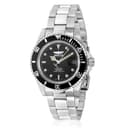
An analogwatch does none of that and is the right answer anyway for plenty of people, because it still looks like a watch when they take the hi-vis off. The Casio Duro, the Citizen Promaster and the Invicta Pro Diver all carry a rotating bezel, which is the analog version of a timer: line the marker up with the minute hand and you can read elapsed time off the dial. It is the only “function” on a dive watch most owners ever use, and it needs no manual.
If you genuinely cannot tell which they would prefer, look at what is on their wrist now. People are very consistent about this one.
The battery question is bigger than it looks
A quartz watch worn hard will need a battery every few years, and here is why that matters more than usual on this page: every time a watch is opened for a battery, its water resistance depends on the gasket being seated correctly again. A watch that has been opened at a mall kiosk is not reliably a 200m watch any more. Our guide to how long a watch battery lasts covers what the makers actually publish and what shortens it.
Two picks here never face that. The Citizen Promaster Diver runs on Eco-Drive, which charges from any light and has no battery to change at all — on a 200m case, that is the single most sensible specification on the page, and it is most of the reason it costs what it costs. The Invicta Pro Diversolves it the other way, with a self-winding automatic movement powered by the wearer’s own motion: no battery either, though a mechanical watch is the one thing here that genuinely minds being knocked about. Our automatic versus solar comparison is the two-minute version of that choice.
What about the trades that are not construction?
The same list works, with one adjustment each. For an electrician, a resin case and strap mean no metal bracelet bridging anything — the DW5600 and the Ironman are the obvious two. For a mechanic, grease is the enemy of a fabric or leather strap, so resin or polyurethane again, and a dark dial hides what the light-coloured ones show. For a firefighter or paramedic, a timer is not a nice-to-have, which pushes you to the two digital picks. For farm and outdoor work, the Timex Expedition North is the one that reads as a proper watch at the end of the day.
And if the person you are buying for is on their feet in a hospital rather than on a site, the brief changes enough to be a different page: see our watch gifts for a nurse, where a sweeping second hand for counting a pulse is the specification that matters most.
Two things not to buy
Do not buy a dressy watch “for best”as a substitute for the working one. It is a lovely idea and it ends in a drawer: a watch that is not worn daily is a watch nobody remembers to wind, charge or put on. If you want to give something smart, give the working watch and spend the rest on a second strap — our watch and strap pairing note covers how to get the width right.
Do not have it engraved.Engraving kills the return, and on a watch that may need to be swapped for a different size or sent back as faulty, that is a real cost. Save it for the retirement watch — our engraving guide explains when it is worth it and when it is not.
The adjacent list, for a different kind of hard day
Everything above is chosen for a jobsite: shock, water, a dial you can read with dust on it. If the person you are buying for is in the services rather than the trades, the constraints change — a uniform rules out anything shiny or oversized, and a watch going to basic training has to be cheap enough to lose without it mattering. Our watch gifts for someone in the military page is written for that, and only two picks overlap with this one.
The one to skip — and why
Skip the Timex Expedition North if the watch will genuinely live on a site all day. It is the nicest watch here — solar, sapphire, 100m, a field dial that looks right with anything — and that leather strap is the wrong material for the job: it will absorb water, dust and whatever else is on the ground. It is on this list for the tradesperson who wants one good watch for the rest of the time, not one for the work. For a pick that does both, the Citizen Promaster and its polyurethane strap are the honest answer. And skip a steel-bracelet watch of any kind for anyone working around machinery: a bracelet that catches is a hazard, not a style choice.