The exam-hall rule, stated carefully
We are not going to claim a universal policy, because there is not one. What is true across almost every published invigilation rule we can read is the principle: a device capable of receiving information is prohibited; a mechanical or quartz analog watch is not. Many institutions have moved further and ban all wristwatches from the desk, requiring them to be placed in a bag — in which case a watch is still useful for the walk there and useless for the three hours. Check the specific course handbook. What you can safely assume is that a watch with hands and no radio in it is the version with the best chance of being allowed, and a smartwatch is the version with none. Our watch-versus-smartwatch comparison covers the wider version of that choice.
What a student budget buys, step by step
| Budget | What you get | The pick |
|---|
| About $22 | A 33mm digital classic, resin strap, splash resistance only | Casio F-91W |
| About $45–$55 | A 38mm analog with an interchangeable strap, or a 100m digital for the pool | Timex Weekender, Timex Ironman Classic 30 |
| About $93–$107 | A steel bracelet or an interchangeable-strap minimalist — the first watch that looks considered | Timex Q Reissue, Daniel Wellington Petite |
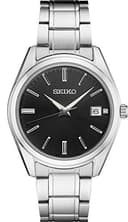
| About $212 | A sapphire crystal, 100m and a 40mm case that works with a suit | Seiko Essentials SUR311 |
The one step with a genuinely different outcome is the top one. The Seiko is the only pick on this page with a sapphire crystal, and it is the only one that will look new at the end of four years and then carry on into a first job. If this gift is meant to last past graduation, that is the pick; if it is meant to survive a dorm, the Weekender is the honest answer and the $160 difference is better spent elsewhere.
The three failure modes of a student watch
It gets left somewhere. Shared bathrooms, gym lockers and library desks. This is the single best argument for spending under $100, and for choosing a watch whose strap can be replaced for $10 rather than one whose bracelet needs a jeweler.
It goes in water it was not rated for.Four of the picks here are rated 30m or “splash only”, which does not cover a shower or a pool — a distinction almost no student knows. If they swim, the Ironman at 100m is the pick; our showering guide has the rating-by-rating version and the water-resistance explainer covers why the number is not a depth.
Their taste changes. Between eighteen and twenty-two it usually does. The hedge is a watch with an interchangeable strap: the Weekender’s slip-through strap and the Daniel Wellington’s quick-change system both let the recipient change the whole look for the price of lunch, which keeps a gift in rotation long after the original choice stopped being their style. The strap-changing guide is the five-minute version if the watch they already own is the one being updated.
Nursing, engineering and the course-specific cases
Two courses have a real specification attached. Nursing and allied health students need a second hand they can read for a pulse, and many placements prohibit a wrist watch entirely on hand-hygiene grounds — a fob watch is the usual answer, and our picks for a nurse cover that properly. Engineering and lab students want something they can get dirty and read quickly; the engineer page is the fuller version. For everyone else, the generic student brief above holds.
The one to skip — and why
Skip the university-branded watch from the campus store, however well-meant. The crest on the dial means it can only be worn in the four years it is least needed, the movements in them are usually unbranded, and it cannot be returned or resized. Skip a smartwatch too, unless you have checked they want one and checked the exam rules — it is the single most likely gift to be banned on the one day a watch would have helped. A plain analog watch with a replaceable strap does the job for less money and keeps doing it afterwards.