Why retro watches look like this: the decade that made them
Four of the seven picks here are either digital or descend from a design made in the same twenty-year window, and that is not a coincidence. The quartz crisis — called the quartz revolution in the United States and Japan — was the upheaval caused by quartz watches in the 1970s and 1980s, which largely replaced mechanical watches around the world. It began with the Seiko Astron, the world’s first quartz watch, introduced in December 1969. Its key advances were replacing the mechanical movement with a quartz one and replacing analog displays with digital LED and later LCD displays.
The Swiss industry, which had held about 50% of the world watch market and stayed focused on traditional mechanical watches, declined significantly, while production shifted to Japanese companies — Seiko, Citizen and Casio — that embraced the new electronics. That is why the retro watch market at gift prices is overwhelmingly Japanese and overwhelmingly digital: those were the designs being made in volume when the look you are shopping for was simply what a watch looked like. The Bulova on this page comes from the other side of the same story — Bulova began marketing the Accutron, an electronic watch using a tuning fork resonating at 360 Hz, in 1960, almost a decade before the Astron.
Four things decide a retro watch, and authenticity is only one
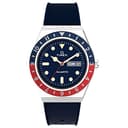
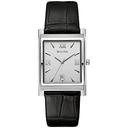
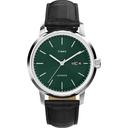
1. Is it the brand’s own design, or a copy of someone else’s? This is the line we hold on this page. Every pick below is a watch the maker is reissuing or still producing from its own back catalogue — Timex’s Q and Marlin, Casio’s Vintage line, Bulova’s Classic rectangle and its own lunar chronograph homage. A no-name watch styled after a famous Swiss one is a different product and we do not list any.
2. The crystal, and whether period-correct is what you want. Four picks here use acrylic, which is what these designs originally had: it is plastic, it scratches easily, and polish takes marks straight out of it. Mineral glass resists scratches better but chips rather than polishes. Sapphire is the hard one, and exactly one watch on this page has it, and it is the most expensive one — which is honest rather than ideal, and a fair summary of what the category costs. Our sapphire vs mineral crystal guide has the trade in full.
3. Size, because old designs are small. A 1970s watch was 33mm to 38mm, and the picks here run from a 29mm-wide rectangle to a 45mm chronograph. On a large wrist the Casios read as small, and a buyer used to a modern 42mm watch should know that before unwrapping. On a slim wrist, they are exactly right. The watch size guide is the two-minute check.
4. Water resistance, which the retro look does not improve. Two of the three Casios here are splash-only, meaning hands and rain and nothing more, and the third publishes no rating at all. The two Timexes publish 50m, the Bulova chronograph 50m and the Bulova dress watch 30m. If the recipient is going to wear one watch for everything, the water rating matters more than the decade; our water resistance explainer is the ladder.
Should you buy an actual vintage watch as a gift? No, and here is why
We get the appeal, and this is the most useful paragraph on the page. A genuinely old watch is a maintenance commitment that you are handing to somebody else without asking. Four specific problems come with it. Its water resistance is gone — gaskets harden and a 50-year-old seal is a decorative claim, so the recipient cannot wash their hands without thinking. It will eventually need a service, and a mechanical service costs real money that the recipient, not you, will pay. It has no warranty and no returns in any meaningful sense. And you cannot size it discreetly: a vintage bracelet often cannot be lengthened at all, so if it does not fit, it does not fit.
There is one more that matters for a gift specifically: you cannot verify what you are buying. Dials get refinished, hands get swapped, cases get polished thin and parts get mixed between references, and none of that is visible in a listing photo. Our guide on how to tell if a watch is real covers what can and cannot be checked. A reissue sidesteps every one of these: same design, new gaskets, current warranty, and a strap or bracelet that can be sized at a counter.
The two we would most like to recommend and cannot
Both are in our registry and neither is a pick, and the reason is the same for both: our daily price check returns no live price, so we will not put a buy button on them. They are named here because they are the honest answer to “what is the best retro watch,” and leaving them out would make this page look more complete than it is.
The Timex Marlin Hand-Wound Reissue is the one we would choose over everything on this list. It is a 34mm reissue with an acrylic crystal and a hand-wound mechanical movement — no battery, no rotor, you wind it every morning — which is the single most period-correct thing a watch can do. The quartz Marlin that is a pick above shares the line and the look, is larger at 38mm, and adds 50m of water resistance; what it does not share is the movement, and we would rather say that plainly than let the shared name do the work.
The Seiko Recraft SNKP27 is the other: a rectangular steel case with a teal dial, a day/date and a Seiko 7S26 automatic behind a see-through caseback. It is the only retro-styled automatic in our registry at gift money. If a rectangular retro case is the appeal, our Cartier Tank alternatives page is built around exactly that shape and reaches the same conclusion about this reference.
So the honest version of the headline on this page is this: every retro watch we can verify on a live price today runs a battery. If a mechanical movement matters more than the decade, buy a round automatic and stop fighting the category — best automatic watches under $200 is the short list at similar money, and one of the four on it publishes a jewel count and a daily accuracy figure that nothing on this page does.
The Casio question: three of these are nearly the same watch
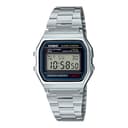
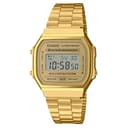
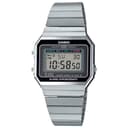
Worth being blunt about, because the listings will not be. The A158WA, the A168 gold-tone and the A700 are all from the same Casio Vintage family and they do the same job. Choose between them on three things and ignore the rest. The A158WA is the cheapest and the plainest, 33mm in steel. The A168 gold-tone is the one people actually notice, at 36mm, and gold-tone is a color description rather than a material claim — it is a plated finish and no listing in this band publishes a plating thickness. The A700 is the thin one, and it is the only Casio here with a mineral crystal rather than acrylic, although it does not publish a water resistance rating at all.
All three are splash-only or unpublished on water, all three are resin-and-steel rather than solid steel, and all three will look identical across a room. If the recipient wants a digital watch rather than a retro one specifically, best digital watches is the page with the G-Shock and the Ironman on it, and best Casio watches covers the whole range honestly.
The one with an actual story, if that is what you are buying
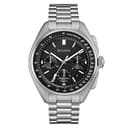
The Bulova Lunar Pilot is the most expensive watch here by a wide margin and the only one with a sapphire crystal, and it earns its place on a retro page on history rather than styling. David Scott carried a Bulova chronograph on Apollo 15 in 1971 and used it on his third lunar walk after the crystal popped off his Omega; reference literature calls it the only privately owned watch to have been worn on the lunar surface, and records that it sold for $1.625 million at auction in 2015 and that Bulova released an homage edition using a modern quartz movement in early 2016.
Two things to be straight about. This is an homage to that watch, not that watch, and it runs a modern quartz chronograph movement rather than a mechanical one. And at 45mm it is a big watch — the biggest on this page — which on a slim wrist is simply the wrong gift regardless of the story. The longer version of its history, and the five watches we would buy instead of the original, are on Omega Speedmaster alternatives.
The one to skip — and why
Skip the acrylic-crystal picks for anyone who is hard on a watch. Acrylic marks from the things that do not touch mineral glass — a doorframe, a desk edge, a bag zip — and while those marks polish out, somebody has to do it. For a tradesperson, a nurse on shift or a gardener, buy the specification instead of the decade: a mineral or sapphire crystal and a real water rating. Our best everyday watches are chosen for exactly that life.