The second time zone, and the honest limits of this list
The feature travellers actually want is the ability to read two times at once: where they are, and where the people they are calling are. There are three ways a watch does it, and they are not equally available.
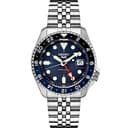
- A GMT hand.A fourth hand that circles the dial once every 24 hours, pointing at a second zone, usually with a 24-hour scale to read it against. The Seiko 5 Sports SSK003 does this with Seiko’s 4R34 movement, which brought a mechanical GMT under $500 for the first time in 2022. Its 24-hour bezel rotates, so a determined owner can track a third zone as well.
- A world-time digital. A digital module with a second city you flip to with a button, which is the cheapest and easiest version of the feature. We hold no verified listing for a world-time digital watch in our registry, so there is nothing for us to recommend here and we would rather say that than point you at something we have not checked. If that is the feature you want above all others, buy the function rather than our list.
- A second watch, or the bezel trick.On any watch with a rotating bezel — the Citizen Promaster here — you can set the marker to home time and read the offset off it. It is not elegant, it is free, and plenty of people do it.
If a second time zone is not actually the priority, say so to yourself before you spend: the other five picks here are better travel watches in every respect except that one.
Nothing to charge is the real luxury
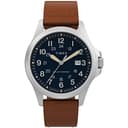
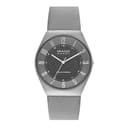
The most underrated travel specification is a movement that needs no intervention. Three picks here are solar — the Timex Expedition North, the Citizen Promaster Diver and the Skagen Grenen — and they charge from any light, including the light coming through an aeroplane window. Timex publishes a four-month power reserve for the Expedition North, so a watch left in a drawer between trips is still running when the next one starts. One pick, the Seiko GMT, is automatic: it winds itself from wrist motion and has no battery at all, though it does stop after a day or two off the wrist and needs resetting.
The practical point is this. A quartz watch that dies in week two of a three-week trip is a dead object on your wrist, because a watch battery is not a thing you can reliably buy and have fitted abroad — and a battery change done badly is also how a water-resistant watch stops being one. Our guide to how long a watch battery lasts covers how to tell whether a watch is about to need one.
Water resistance: what a holiday actually asks for
A travel watch meets water more often than a home watch does — a pool, the sea, a snorkel trip, a downpour that arrives in ninety seconds. Ratings are static pressure tests rather than activity permissions, which our note on what water resistance means explains properly, but the rough reading is reliable: 30m is splashes, 50m survives rain and hand-washing, 100m is fine for swimming, and 200m covers snorkelling and anything else a holiday involves.
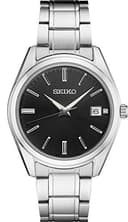
On this page the Citizen Promaster Diver is rated 200m, the Seiko GMT, the Timex and the Seiko Essentials are 100m, the Skagen is 30m, and the Casio F-91W is splash-only. If the trip is beach-shaped, that ordering is most of your decision. If it is city-shaped, it barely matters.
The pick nobody expects: the cheapest one
The Casio F-91W is on this list because of a specific travel truth: the watch you are relaxed about is the watch you actually enjoy wearing. It costs about as much as two airport coffees, weighs nothing in a bag, has an alarm for a 6am transfer and a stopwatch, and its listing states a battery life of around seven years. If it is stolen from a hostel locker you will be annoyed for about a minute.
It is also the right answer for a very specific gift: someone travelling somewhere where an obviously valuable watch is a liability. A plain black resin Casio is the opposite of a target. The one real limitation is that Casio rates it splash-resistant only — it is not for the pool.
What to give someone who wants one watch for the whole trip
This is the most common version of the request, and it has a clean answer: the Seiko Essentials SUR311. A sapphire crystal that will not pick up scratches from a rucksack strap, 100m water resistance, a 40.2mm steel case that reads as smart with a shirt and fine with a t-shirt, and a plain dial that does not announce itself. It has no travel function at all, which is exactly why it works for the traveller who was never going to use one.
For a dressier version of the same idea the Skagen Grenen Solar is 37mm, thin, light and solar-powered, on a mesh band that adjusts by hand with no tools — useful when you are buying for someone whose wrist you have never measured. Its 30m rating is the thing to know: it is not a pool watch.
Three things to sort before they fly
- Size the band before the trip, not during it.A steel bracelet needs links removed, which is a jeweler job — see our band resizing guide. A mesh band or a leather strap adjusts by hand, which is why both appear on this page.
- Set the time zone function once, together.A GMT is set differently from an ordinary watch, and an automatic GMT like the SSK003 is a “caller” GMT, which is set differently again. Two minutes with the instructions before departure saves a bewildered afternoon later.
- Do not pack the only watch they own in checked baggage. Wear it, or carry it. This sounds obvious and is the single most common way a travel watch gets lost.
The one to skip — and why
Skip the Skagen Grenen Solar for a beach or watersports trip. It is a lovely, light, solar travel watch for cities and flights, and its 30m rating means splashes only — not a pool, not the sea, not a shower. Buy the Citizen Promaster Diver for that trip instead. And skip the Seiko GMT for a first mechanical watch on a long trip unless the recipient already understands automatics: it stops after a couple of days in a hotel safe, which is normal and will still feel like a fault to someone who has never owned one.