Why doctors wear watches at all
It is a fair question when every phone has a clock, and the answer is practical rather than nostalgic. A watch is readable without taking a hand out of a glove or a phone out of a pocket, it does not need unlocking, and it does not have to be set down on a surface in a clinical area. For counting a pulse or a respiratory rate against a moving second hand, it is simply the right tool, which is also why it is the one spec we refuse to compromise on below.
That is the good news for a gift buyer: a watch is one of the few presents a doctor will genuinely use at work every day, which is a much higher bar than most gifts clear.
The one thing to check before you buy: the local dress code
Some clinical environments operate a “bare below the elbow” policy, in which wristwatches are not worn in clinical areas at all and staff use a fob watch pinned to a uniform instead. Policies differ by country, by hospital and by department, and a surgeon’s day is not a dermatologist’s.
This is worth one question to someone who knows, because it changes the gift completely. If a wrist watch is not worn on shift, then the watch you are buying is for the rest of their life rather than for work — which argues for the nicest dress watch in your budget rather than the most scrubbable one. If a wristwatch is fine, read on.
What each price band actually buys here
- Around $100. The Casio G-Shock is the odd one out on this page and the most-used watch on it for some people: resin, 200m, a timer, a stopwatch and a backlight for a night shift, and nothing anyone will mind getting scuffed. It is a working watch, not a keepsake.
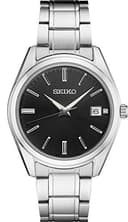
- Around $200. The Seiko Essentials SUR311 is the value answer and arguably the best-specified watch on the page for the money: a sapphire crystal, 100m, a 40.2mm steel case and a clean dial with a second hand. If the gift is from a group or a budget is fixed, this is where to put the money.
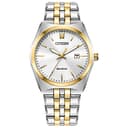
- Around $220 to $320.Both Eco-Drive picks sit here. The Citizen Corso and the women’s Citizen Peyten run on light, so the back is never opened for a battery — which matters, because a case that has been opened is only as water-resistant as the person who closed it. The Peyten adds a sapphire crystal and a 100m rating in a 33mm case, which is a rare combination at that size.
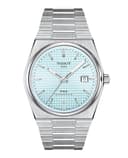
- $450 and up. The two Tissots. The PRX Quartz is the milestone-gift answer: Swiss, sapphire, 100m, and an integrated bracelet with no gaps for anything to lodge in. The PRX Powermatic 80 is the same watch with a Swiss automatic movement instead of a battery, for a recipient who would rather have the machine. Our guide to how much to spend is the broader version of this ladder.
Sapphire earns its keep in a hospital
Scratches are the way a milestone watch stops looking like one, and a clinical day is full of door frames, bed rails and trolleys. Sapphire is dramatically harder than mineral glass — the detail is in our sapphire versus mineral crystal note — which is why four of these six picks have it and why we would choose it over almost any other upgrade at this price. If you are deciding between two watches and one has a sapphire crystal, that is the tiebreak.
Bands: what to avoid, and why the bracelet wins here
On most pages of this site we argue for a strap that adjusts without a jeweler, because a gift should fit on the day it is opened. This is the one page where we argue the other way. A steel bracelet — and especially an integrated one like the PRX — can be wiped down properly, which fabric cannot and textured leather does badly. Links do have to be removed to size it, which normally means a short trip to a jeweler; our band resizing guide explains the job, and it is worth the inconvenience here.
If the recipient reacts to metal, that calculation changes — see our note on watches for sensitive skin, which covers what can and cannot be checked before you buy.
Nurse, doctor, medical student: which list do you want?
These two pages are deliberately different. Our watch gifts for a nurse is a working-tool list built for someone on their feet for a twelve-hour shift, and it leans cheaper, lighter and more replaceable. This page is built around the milestone, so it leans toward a watch worth keeping. A medical studentis better served by the nurse page plus a gift receipt, or by the Seiko Essentials here — a watch that survives clinical rotations is more useful than one they will be nervous about.
If the occasion is the qualification itself, our graduation watch picks cover the engraving and presentation side of it, and our gift-card wording guide is genuinely useful for a gift this loaded.
The one to skip — and why
Skip anything on a fabric or suede strap, however good it looks: porous materials in a clinical setting trap moisture and whatever is on the wearer, and they cannot be wiped down. Skip a 30m watch, which is a splash rating and not enough for a day of hand-washing. And skip an automatic as a working watch for a surgeon or anyone who scrubs: a mechanical watch minds knocks, and the PRX Powermatic is on this page as a keepsake for someone who already knows that and wants the movement anyway. For a working watch that never needs a battery, the Eco-Drive picks are the better answer.